Revenue
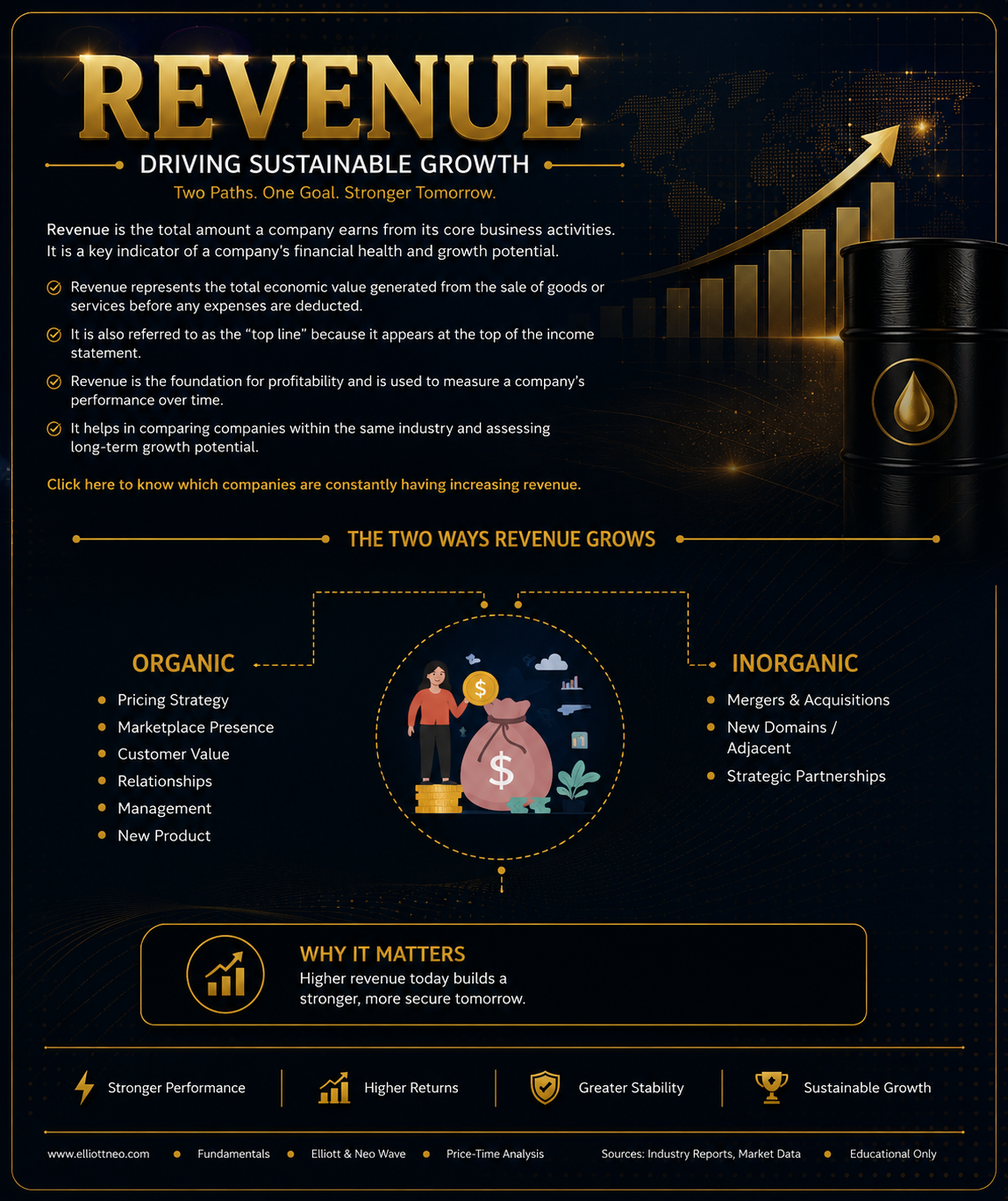
RevenueRevenue is the starting point of every income statement and one of the most closely monitored indicators of a company's financial performance. Often referred to as the "top line," revenue represents the total income earned by a business through its primary operating activities before any expenses are deducted. It reflects the company's ability to generate sales by delivering products or services that customers value and are willing to purchase. Regardless of the industry in which a company operates, revenue acts as the foundation upon which profitability is built. Without a consistent and growing stream of revenue, a business cannot sustain its operations, invest in expansion, reward its shareholders, or maintain its competitive position in the marketplace. Consequently, understanding the nature, quality, and drivers of revenue is an essential aspect of financial statement analysis.Revenue is generated through a company's core business activities. For a manufacturing company, it primarily consists of income earned from selling finished goods. For a retailer, revenue is derived from selling merchandise to consumers. A software company earns revenue by licensing software products, offering subscription-based services, or providing technical support. Financial institutions generate revenue through interest income, fees, commissions, and other financial services, while consulting firms derive their revenue from professional advisory services. Although the source of revenue differs across industries, its significance remains the same because it represents the economic value created by the business through its normal operations.The recognition of revenue follows established accounting principles to ensure that financial statements present a fair and accurate view of business performance. Revenue is generally recognized when the company has fulfilled its performance obligation by transferring goods or services to the customer, and there is reasonable certainty that payment will be received. This principle prevents businesses from recording anticipated future sales as current revenue, thereby improving the reliability and comparability of financial reports. Accurate revenue recognition also enhances investor confidence because it ensures that reported financial performance reflects genuine business activity rather than accounting manipulation.While revenue is often associated with business success, analysing revenue requires much more than simply observing whether sales have increased or decreased. Financial analysts seek to understand the quality, sustainability, and source of revenue growth. A temporary increase in sales resulting from heavy discounting, promotional campaigns, or seasonal demand may not necessarily indicate long-term business improvement. In contrast, consistent revenue growth driven by expanding customer demand, product innovation, geographical expansion, or improved market share generally reflects a healthier and more sustainable business model. Therefore, experienced analysts distinguish between temporary fluctuations and structural growth while evaluating a company's revenue performance.Revenue growth is widely regarded as one of the strongest indicators of business expansion. Companies that consistently increase their revenue over multiple reporting periods often demonstrate strong customer demand, effective management strategies, competitive products, and the ability to adapt to changing market conditions. Continuous growth also indicates that the company is successfully attracting new customers while retaining existing ones. Businesses capable of maintaining this momentum over several years frequently create significant shareholder value because increasing revenue provides opportunities for higher profitability, operational expansion, and greater market influence.However, revenue growth should always be analysed alongside profitability. Rapidly increasing sales accompanied by declining profit margins may indicate that the company is sacrificing profitability to boost market share through aggressive pricing or excessive promotional spending. Similarly, revenue expansion financed by unsustainable credit policies or excessive customer incentives may create future collection risks. Therefore, financial statement analysis emphasizes the importance of evaluating both revenue growth and the efficiency with which that revenue is converted into profits.One of the most important distinctions in revenue analysis is the difference between organic growth and inorganic growth. Organic revenue growth refers to the increase in sales generated through the company's existing business operations. This growth occurs naturally as a result of higher production, improved product quality, increased customer demand, successful marketing initiatives, expansion into new geographical markets, enhanced distribution networks, or the introduction of innovative products and services. Organic growth demonstrates management's ability to strengthen the business using its internal resources and operational capabilities. Because it reflects genuine business improvement, investors generally consider organic growth to be a reliable indicator of long-term corporate strength.For example, a consumer electronics company that launches a technologically advanced smartphone and experiences higher sales because of strong customer acceptance is generating organic revenue growth. Similarly, a pharmaceutical company that develops a successful new medicine or a retail chain that expands its presence into underserved regions through new store openings is also achieving organic growth. In each of these cases, revenue increases because the company's own operations have become more effective and competitive.In contrast, inorganic revenue growth results from mergers, acquisitions, joint ventures, or business combinations rather than improvements in the company's own operations. By acquiring another company, an organization can immediately increase its reported revenue because the acquired company's sales become part of the consolidated financial statements. Inorganic growth often enables businesses to expand more rapidly than would be possible through internal development alone. It may provide access to new markets, advanced technologies, established customer bases, valuable intellectual property, or specialized expertise.Although inorganic growth can accelerate expansion, it also introduces significant risks. Acquisitions often require substantial financial investment, and integrating different organizations can present operational, cultural, and managerial challenges. If the acquisition price is excessively high or expected synergies fail to materialize, profitability may decline despite higher reported revenue. Consequently, financial markets typically reward acquisitions only when they enhance long-term shareholder value and generate returns that justify the acquisition cost. Poorly executed mergers, excessive acquisition premiums, or unsuccessful integrations may result in declining profitability, increased debt, and reduced investor confidence.Analysing revenue also requires understanding the consistency of sales across reporting periods. Businesses with stable and predictable revenue streams generally receive higher valuations because consistent earnings reduce uncertainty for investors. Companies operating in sectors such as information technology, consumer goods, healthcare, and essential services often benefit from recurring customer demand and relatively stable revenue patterns. These businesses are frequently referred to as consistent compounders because they demonstrate steady growth in both revenue and profitability over extended periods.Conversely, companies operating in cyclical industries often experience significant fluctuations in revenue due to changing economic conditions, commodity prices, or consumer demand. Industries such as steel, cement, automobiles, real estate, and construction typically perform exceptionally well during economic expansion but may experience declining sales during economic slowdowns. Investors recognize these cyclical characteristics and often assign lower valuation multiples to businesses with unpredictable revenue patterns because future earnings are inherently less certain.Revenue quality extends beyond its growth rate to include customer diversification and revenue concentration. Companies heavily dependent upon a small number of customers face greater business risk because the loss of a major client can significantly reduce future revenue. On the other hand, businesses serving a broad customer base across multiple industries and geographical regions generally enjoy greater financial stability. Diversified revenue sources reduce dependence on individual customers or markets while improving resilience during changing economic conditions.Another important aspect of revenue analysis involves understanding pricing power. Businesses possessing strong brands, technological advantages, superior quality, or unique market positions often retain the ability to increase product prices without significantly reducing customer demand. Pricing power enables companies to offset rising production costs while protecting profit margins. Companies lacking pricing power, however, may struggle to pass higher input costs to customers, resulting in declining profitability even if revenue remains stable.Financial analysts also compare revenue growth with industry averages and competitor performance. A company reporting five percent annual revenue growth may appear successful in isolation. However, if the broader industry is growing at fifteen percent annually, the company's performance may actually indicate declining market share. Conversely, modest revenue growth during periods of industry contraction may demonstrate strong competitive positioning. Industry benchmarking therefore provides essential context for evaluating revenue performance accurately.Seasonality represents another factor influencing revenue analysis. Many businesses experience predictable fluctuations in sales throughout the year. Retailers often generate substantial revenue during festive seasons, tourism businesses perform better during holiday periods, and agricultural companies depend upon harvesting cycles. Analysts therefore compare revenue with corresponding periods in previous years rather than relying solely on sequential quarterly comparisons. This approach provides a more meaningful assessment of underlying business trends.Revenue should never be interpreted independently of other financial statement components. Strong revenue growth unsupported by healthy operating margins, efficient cash collection, or sustainable profitability may indicate underlying weaknesses. Consequently, analysts examine revenue alongside expenses, profits, receivables, inventory levels, and operating cash flows to develop a comprehensive understanding of business performance. When revenue growth is accompanied by improving profitability, efficient working capital management, and positive operating cash flows, it generally indicates a financially healthy and well-managed organization.Ultimately, revenue represents much more than the total value of goods sold or services provided. It reflects customer confidence, market acceptance, competitive strength, operational effectiveness, and the company's ability to generate economic value through its core business activities. Careful analysis of revenue enables stakeholders to evaluate business growth, assess management performance, identify emerging opportunities, recognize potential risks, and estimate future earning potential. As the first and most visible component of the Income Statement, revenue provides the starting point for understanding corporate financial performance, making it one of the most important elements of financial statement analysis and a critical indicator of long-term business success.
Mastering revenue builds lasting financial clarity, confidence, and disciplined execution.
Core Concepts & Foundational Principles
Summary & Key Takeaways
Mastering revenue is vital for developing sound financial and investment discipline..
Core Principle: Revenue
Key Mechanics & Frameworks
Consistent long-term habits create significantly greater wealth than short-term speculative decisions..
Continuous study and structured application of Financial Statement Analysis A Comprehensive Guide to Understanding Income Statements, Balance Sheets, and Cash Flow Statements for Smart Investment Decisions empowers smart decision-making..
Summary & Key Takeaways
- Consistent long-term habits create significantly greater wealth than short-term speculative decisions.
- Mastering revenue is vital for developing sound financial and investment discipline.
- Summary & Key Takeaways.