Participants in the Stock Market
The stock market is often viewed as a place where investors buy and sell shares. While this is true, the smooth functioning of the market depends on the coordinated efforts of several participants, each performing a distinct role. From individual investors and large financial institutions to stockbrokers and regulatory bodies, every participant contributes to maintaining an efficient, transparent, and secure marketplace.At the heart of the stock market are investors. Investors provide the capital that businesses need to grow and expand. In return, they expect to earn returns through capital appreciation, dividends, or both. Investors vary in terms of their financial resources, investment objectives, and risk tolerance, but they all share the common goal of increasing the value of their investments over time.One of the largest groups of market participants is retail investors. These are individual investors who buy and sell securities using their personal savings. Retail investors may invest for various reasons, including long-term wealth creation, retirement planning, education funding, or achieving personal financial goals. With the advancement of digital trading platforms and mobile applications, participation by retail investors has grown significantly, making the stock market more accessible than ever before.In contrast, institutional investors manage large pools of money on behalf of individuals or organizations. This category includes mutual funds, insurance companies, pension funds, banks, and foreign institutional investors (FIIs). Because they invest substantial amounts of capital, institutional investors often have a significant influence on market movements. Their investment decisions are usually based on detailed financial analysis, economic research, and long-term investment strategies.Another important participant is the stockbroker. Stock exchanges do not allow individual investors to trade directly on their platforms. Instead, investors place their buy or sell orders through registered stockbrokers. A stockbroker acts as an intermediary between the investor and the stock exchange, ensuring that transactions are executed efficiently and in accordance with market regulations. Today, many brokerage firms provide online trading platforms that allow investors to monitor markets and execute trades from virtually anywhere.Every transaction executed in the stock market must be completed through a process known as clearing and settlement. This responsibility is handled by clearing corporations, which ensure that shares are delivered to buyers and payments are made to sellers. Clearing corporations also reduce the risk of default by guaranteeing the completion of trades, thereby maintaining confidence in the financial system.The safe custody of securities is managed by depositories. In the past, share certificates were issued in physical form, making them vulnerable to damage, loss, or forgery. Today, almost all securities are held electronically through depositories. Investors maintain a Demat (Dematerialized) Account, where their shares are stored securely in digital form. This electronic system has significantly improved the speed, security, and convenience of securities transactions.Depositories provide their services through Depository Participants (DPs), which act as intermediaries between investors and the depository. Banks, financial institutions, and registered brokerage firms often function as Depository Participants, enabling investors to open and manage their Demat accounts with ease.The stock market is also governed by a regulatory framework designed to protect investors and ensure fair trading practices. In India, this responsibility lies with the Securities and Exchange Board of India (SEBI). Established to regulate the securities market, SEBI develops rules that promote transparency, prevent fraudulent practices, and safeguard the interests of investors. It supervises stock exchanges, brokers, listed companies, and other market intermediaries to ensure compliance with established regulations. Through its regulatory role, SEBI has played a vital part in strengthening investor confidence and improving the integrity of India's capital markets.Apart from these primary participants, listed companies themselves are integral to the functioning of the stock market. Companies raise capital by issuing shares, communicate financial information to investors, and comply with regulatory disclosure requirements. Their financial performance, strategic decisions, and corporate governance practices directly influence investor confidence and market performance.The interaction among all these participants creates a well-organized financial ecosystem. Investors provide capital, companies utilize it for growth, brokers facilitate transactions, depositories safeguard securities, clearing corporations ensure the completion of trades, and regulators oversee the entire system to maintain fairness and transparency. Each participant performs a specialized function that contributes to the overall efficiency and stability of the stock market.Understanding the roles of these participants helps investors appreciate that the stock market is not simply a place where shares are traded. It is a highly structured system supported by institutions that work together to ensure that every transaction is conducted securely, efficiently, and ethically. This knowledge forms an important foundation for anyone seeking to participate in the financial markets with confidence and responsibility.
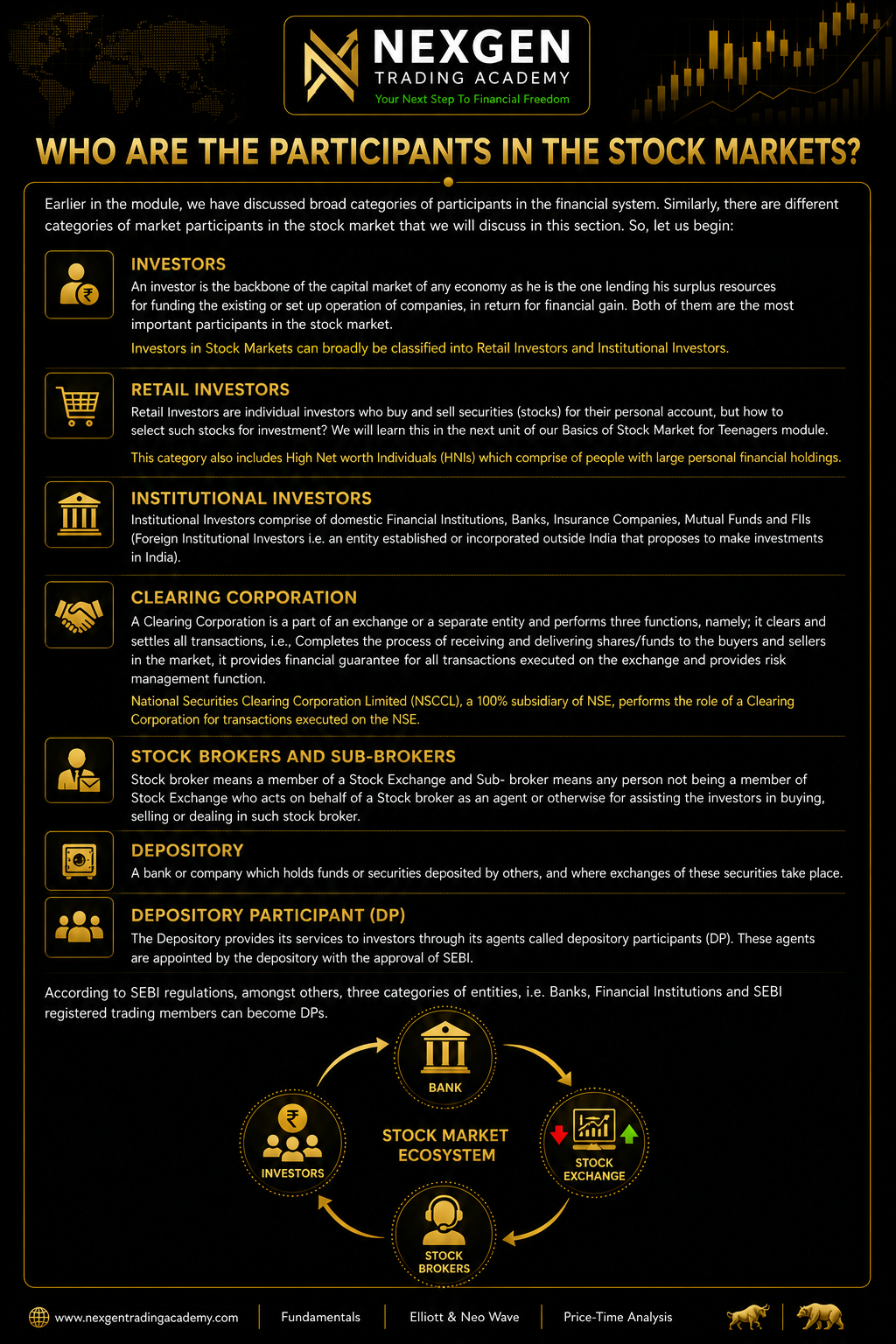
Mastering participants in the stock market builds lasting financial clarity, confidence, and disciplined execution.
Core Concepts & Foundational Principles
Summary & Key Takeaways
Mastering participants in the stock market is vital for developing sound financial and investment discipline..
Core Principle: Participants in the Stock Market
Key Mechanics & Frameworks
Consistent long-term habits create significantly greater wealth than short-term speculative decisions..
Continuous study and structured application of Basics of Stock Market for Teenagers A Beginner's Guide to Understanding Investing, Financial Markets, and Wealth Creation empowers smart decision-making..
Summary & Key Takeaways
- Consistent long-term habits create significantly greater wealth than short-term speculative decisions.
- Mastering participants in the stock market is vital for developing sound financial and investment discipline.
- Summary & Key Takeaways.