Understanding Stock Market Indices
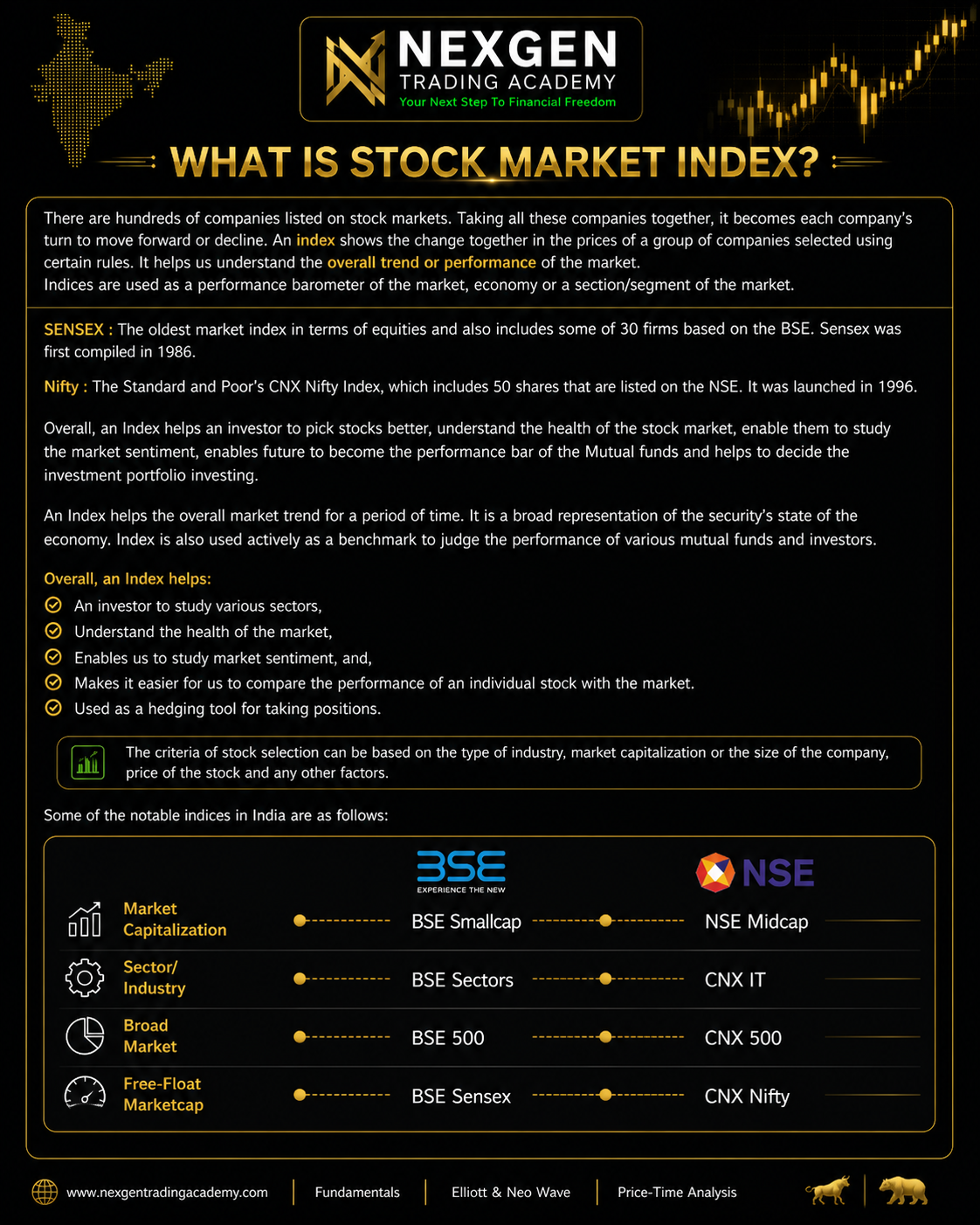
The stock market consists of thousands of companies operating across different industries. Monitoring the performance of every listed company individually is neither practical nor efficient. Investors, analysts, and policymakers therefore rely on stock market indices to obtain a clear picture of the market's overall direction and performance. A stock market index serves as a benchmark that summarizes the movement of a selected group of companies, making it easier to understand whether the market is generally rising, falling, or remaining stable.A stock market index is created by selecting companies that represent different sectors of the economy. These companies are chosen based on factors such as market capitalization, liquidity, financial strength, and trading activity. The combined performance of these selected companies is then calculated to produce a single numerical value, known as the index. Rather than tracking individual share prices, investors can observe the movement of the index to understand the broader trend of the market.An index performs several important functions in the financial system. It provides a quick snapshot of market conditions, allowing investors to assess whether investor confidence is strong or weak. A rising index generally indicates optimism among market participants and positive expectations about economic growth, while a declining index may reflect uncertainty, weaker corporate performance, or unfavorable economic conditions. Although an index does not guarantee the performance of every listed company, it offers a useful overview of the market's general direction.India has two major benchmark indices that are widely followed by investors and financial institutions. The S&P BSE Sensex represents thirty well-established companies listed on the Bombay Stock Exchange (BSE). These companies belong to various sectors such as banking, information technology, manufacturing, energy, and consumer goods, making the index a broad representation of the Indian economy. Because of its long history and established reputation, the Sensex is often regarded as one of the primary indicators of market performance in India.The second major benchmark is the Nifty 50, managed by the National Stock Exchange (NSE). As the name suggests, this index consists of fifty large and actively traded companies selected from different sectors of the economy. Like the Sensex, the Nifty 50 aims to reflect the overall performance of the Indian equity market. Due to its wider representation of companies, it is extensively used by investors, fund managers, and researchers for market analysis and performance evaluation.Stock market indices are not static. The companies included in an index are reviewed periodically to ensure that it continues to represent the market accurately. If a company no longer meets the required criteria due to declining performance, reduced market capitalization, or lower trading activity, it may be replaced by another company that better reflects the evolving market. This periodic revision ensures that the index remains relevant and continues to represent the current state of the economy.Indices also play an important role in investment decision-making. Many investors compare the performance of their investment portfolios with benchmark indices to determine whether they are outperforming or underperforming the broader market. Mutual funds, exchange-traded funds (ETFs), and portfolio managers frequently use benchmark indices to measure investment performance and establish investment objectives. In addition, several investment products are specifically designed to replicate the performance of popular indices, allowing investors to gain diversified market exposure without purchasing individual stocks.Apart from measuring market performance, stock market indices help investors identify long-term economic trends. Consistent growth in benchmark indices often reflects expanding business activity, improving corporate earnings, and increasing investor confidence. Conversely, prolonged declines may indicate economic slowdowns, financial uncertainty, or broader market corrections. Policymakers, economists, and researchers also study index movements to evaluate the overall health of the financial markets and the economy.It is important to understand that an index should not be interpreted as the performance of every listed company. While benchmark indices provide valuable insights into market trends, individual companies may perform significantly better or worse than the index depending on their financial strength, industry conditions, and business strategies. Therefore, investors should consider stock market indices as indicators of overall market sentiment rather than as measures of individual company performance.For beginners, understanding stock market indices is an important step toward developing financial literacy. They simplify complex market information into an easily understandable measure and help investors observe how the market responds to economic events, corporate developments, and policy changes. By learning how benchmark indices function, investors gain a broader perspective on market behaviour and are better prepared to analyze individual stocks within the larger context of the economy.In conclusion, stock market indices serve as the pulse of the financial markets. They provide a concise summary of market performance, assist investors in evaluating investment outcomes, and contribute to informed decision-making. As readers continue their journey into stock market education, a clear understanding of benchmark indices will serve as a valuable foundation for interpreting market movements and making well-informed investment decisions.
Mastering understanding stock market indices builds lasting financial clarity, confidence, and disciplined execution.
Core Concepts & Foundational Principles
Summary & Key Takeaways
Mastering understanding stock market indices is vital for developing sound financial and investment discipline..
Core Principle: Understanding Stock Market Indices
Key Mechanics & Frameworks
Consistent long-term habits create significantly greater wealth than short-term speculative decisions..
Continuous study and structured application of Basics of Stock Market for Teenagers A Beginner's Guide to Understanding Investing, Financial Markets, and Wealth Creation empowers smart decision-making..
Summary & Key Takeaways
- Consistent long-term habits create significantly greater wealth than short-term speculative decisions.
- Mastering understanding stock market indices is vital for developing sound financial and investment discipline.
- Summary & Key Takeaways.