Balance Sheet
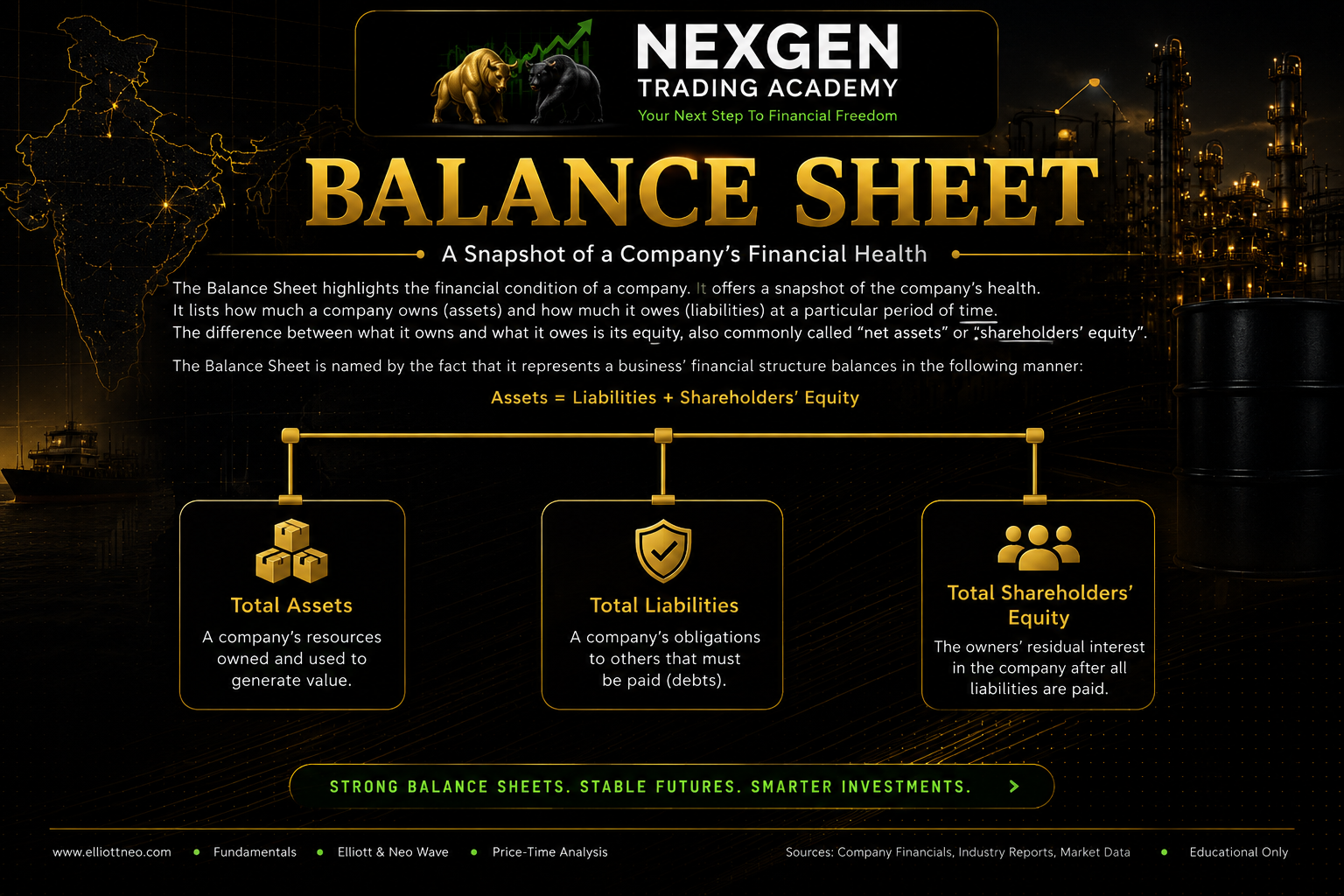
A company's profitability alone does not provide a complete picture of its financial health. While the Income Statement explains how much profit a business has earned during a specific period, it does not reveal what the company owns, what it owes, or how its resources are financed. A business may report substantial profits while carrying excessive debt, insufficient cash reserves, or weak financial stability. To gain a comprehensive understanding of a company's financial condition, investors must study another equally important financial statement known as the Balance Sheet. The Balance Sheet provides a detailed snapshot of the company's financial position at a particular point in time, allowing investors to evaluate its assets, liabilities, shareholders' equity, liquidity, and overall financial strength.The Balance Sheet is one of the three primary financial statements used in fundamental analysis. Unlike the Income Statement, which measures financial performance over an accounting period, the Balance Sheet presents the financial position of the company on a specific date. It records everything the company owns, everything it owes, and the amount of capital invested by its shareholders. Because of this, the Balance Sheet is often described as a financial snapshot of the business.The Balance Sheet is built upon one of the most fundamental principles of accounting:Assets = Liabilities + Shareholders' EquityThis accounting equation ensures that every financial transaction affects at least two components of the Balance Sheet while maintaining overall balance. The resources owned by the company must always be financed either through borrowed funds or through capital contributed by shareholders and accumulated earnings.The first major component of the Balance Sheet is Assets. Assets represent all the economic resources owned or controlled by the company that are expected to provide future economic benefits. These resources allow the business to manufacture products, provide services, generate revenue, and support long-term growth. Investors carefully evaluate the quality and composition of assets because they indicate the company's ability to sustain operations and create future earnings.Assets are generally classified into Current Assets and Non-Current Assets based on the period over which they are expected to be utilized.Current Assets are assets expected to be converted into cash, sold, or consumed within one year or within the company's normal operating cycle. These assets support the day-to-day functioning of the business and play a crucial role in maintaining liquidity. Current Assets commonly include cash and cash equivalents, accounts receivable, inventory, short-term investments, prepaid expenses, and other assets that can be realized in the near future.Among these, Cash and Cash Equivalents represent the company's most liquid assets. They include cash held in bank accounts, petty cash, and highly liquid investments that can be converted into cash quickly with minimal risk. A healthy cash balance provides financial flexibility, enabling the company to meet operational expenses, repay short-term obligations, invest in expansion opportunities, and withstand unexpected economic challenges.Another important Current Asset is Accounts Receivable, which represents money owed to the company by customers who have purchased goods or services on credit. While increasing receivables may indicate strong sales growth, excessively high receivables or prolonged collection periods may also suggest difficulties in recovering customer payments. Investors should therefore examine whether receivables remain proportionate to revenue growth.Inventory represents goods held for sale, raw materials, work-in-progress, and finished products awaiting customers. Efficient inventory management is essential because excessive inventory may increase storage costs and the risk of obsolescence, while insufficient inventory may disrupt business operations and customer satisfaction. Investors often compare inventory growth with revenue growth to assess operational efficiency.In contrast, Non-Current Assets, also known as Long-Term Assets, are resources expected to provide benefits for more than one year. These assets support the company's long-term business operations and are generally not intended for immediate sale. Non-Current Assets typically include property, plant and equipment, machinery, land, buildings, vehicles, furniture, long-term investments, patents, trademarks, goodwill, and other intangible assets.For manufacturing companies, property, plant, and equipment often represent a significant portion of total assets because production activities require factories, machinery, and infrastructure. Service-oriented businesses, on the other hand, may possess fewer physical assets while relying more heavily on intellectual property, technology, and human capital.The second major component of the Balance Sheet is Liabilities. Liabilities represent the financial obligations that the company must repay in the future. These obligations arise from borrowing funds, purchasing goods on credit, or entering into contractual commitments. Investors carefully evaluate liabilities because excessive debt may increase financial risk and reduce the company's flexibility during periods of economic uncertainty.Like assets, liabilities are classified into Current Liabilities and Non-Current Liabilities.Current Liabilities are obligations that must generally be settled within one year. They commonly include accounts payable, short-term borrowings, accrued expenses, taxes payable, and the current portion of long-term debt. Since these obligations require relatively immediate payment, investors analyse Current Liabilities alongside Current Assets to determine whether the company possesses sufficient liquidity to meet its short-term financial commitments.Accounts Payable represent amounts owed by the company to suppliers for goods or services purchased on credit. While trade credit forms a normal part of business operations, excessive growth in accounts payable may indicate cash flow difficulties or delayed supplier payments. Investors should therefore evaluate payable trends in relation to revenue growth and operating cash flow.Short-Term Borrowings include loans and financial obligations that mature within one year. Businesses frequently use short-term financing to manage working capital requirements, seasonal fluctuations, or temporary liquidity needs. However, excessive dependence on short-term debt may increase refinancing risk if cash generation weakens.Non-Current Liabilities, also known as Long-Term Liabilities, include obligations that become payable after more than one year. These commonly include long-term bank loans, corporate bonds, lease liabilities, deferred tax liabilities, and long-term provisions. Long-term borrowings often finance expansion projects, acquisitions, capital expenditure, or strategic investments. While moderate borrowing can support business growth, excessive long-term debt increases financial risk by creating fixed interest obligations regardless of business performance.The third major component of the Balance Sheet is Shareholders' Equity, also referred to as Owners' Equity or Net Worth. Shareholders' Equity represents the residual interest remaining after all liabilities have been deducted from total assets. It reflects the amount that theoretically belongs to the company's shareholders and serves as an important indicator of financial strength.Shareholders' Equity generally consists of Share Capital, Retained Earnings, and various reserves.Share Capital represents the funds invested by shareholders through the purchase of equity shares. This capital forms the foundation of the company's ownership structure and remains invested unless altered through corporate actions such as buybacks, bonus issues, or rights issues.Retained Earnings represent the cumulative profits that the company has chosen to retain within the business rather than distribute as dividends. These retained earnings provide an important source of internal financing for future expansion, research and development, acquisitions, debt reduction, and capital investment. Companies with consistently growing retained earnings often demonstrate sustainable profitability and prudent financial management.The Balance Sheet provides investors with valuable information regarding the company's financial stability. Businesses possessing strong asset bases, manageable debt levels, healthy cash reserves, and growing shareholders' equity generally demonstrate greater resilience during periods of economic uncertainty. Conversely, companies burdened by excessive liabilities and weak equity positions may face greater financial pressure during challenging market conditions.One of the most important financial ratios derived from the Balance Sheet is the Current Ratio, which compares Current Assets with Current Liabilities. This ratio measures the company's ability to meet its short-term obligations using its short-term resources. A healthy Current Ratio indicates that the company possesses sufficient liquidity to finance daily operations without experiencing financial stress.Another widely used ratio is the Debt-to-Equity Ratio, which compares total debt with shareholders' equity. This ratio helps investors evaluate the company's financial leverage and overall risk profile. Businesses maintaining balanced debt levels generally enjoy greater financial flexibility than companies heavily dependent on borrowed funds.Investors also analyse Book Value Per Share, which represents shareholders' equity divided by the number of outstanding shares. Book Value provides an estimate of the accounting value attributable to each share and serves as one of several measures used when evaluating company valuation.Although the Balance Sheet provides extensive information regarding financial position, it should never be interpreted independently. A company possessing valuable assets may still perform poorly if those assets fail to generate adequate profits. Similarly, businesses carrying moderate debt may remain financially healthy if they consistently generate strong operating cash flows. Investors should therefore analyse the Balance Sheet together with the Income Statement and Cash Flow Statement to obtain a complete understanding of business performance.The Balance Sheet also allows investors to identify long-term financial trends. Comparing multiple years of Balance Sheets helps determine whether assets are growing, debt remains under control, retained earnings continue increasing, and shareholders' equity strengthens over time. Such long-term analysis provides greater insight than evaluating a single reporting period.Professional investors frequently examine the Notes to Financial Statements accompanying the Balance Sheet because these notes provide detailed explanations regarding asset valuation, contingent liabilities, accounting policies, outstanding legal disputes, and other important financial information that may not appear directly within the Balance Sheet itself.Ultimately, the Balance Sheet represents much more than a list of assets and liabilities. It reflects the company's financial strength, capital structure, liquidity, investment capacity, and long-term stability. Investors who understand how to interpret the Balance Sheet gain valuable insight into the financial foundation supporting the company's operations and future growth.In conclusion, the Balance Sheet is one of the most important financial statements in fundamental analysis because it provides a comprehensive snapshot of a company's financial position at a specific point in time. By analysing Assets, Liabilities, and Shareholders' Equity, investors can evaluate financial stability, liquidity, capital structure, and long-term solvency. When interpreted alongside the Income Statement and Cash Flow Statement, the Balance Sheet enables investors to assess the overall financial health of a business and make well-informed long-term investment decisions based on objective financial evidence rather than market speculation.
Mastering balance sheet builds lasting financial clarity, confidence, and disciplined execution.
Core Concepts & Foundational Principles
Summary & Key Takeaways
Mastering balance sheet is vital for developing sound financial and investment discipline..
Core Principle: Balance Sheet
Key Mechanics & Frameworks
Consistent long-term habits create significantly greater wealth than short-term speculative decisions..
Continuous study and structured application of Stock Investing Basics for Beginners A Practical Guide to Fundamental Analysis, Financial Statements, and Long-Term Wealth Creation empowers smart decision-making..
Summary & Key Takeaways
- Consistent long-term habits create significantly greater wealth than short-term speculative decisions.
- Mastering balance sheet is vital for developing sound financial and investment discipline.
- Summary & Key Takeaways.