Technological Shifts and Market Transformation
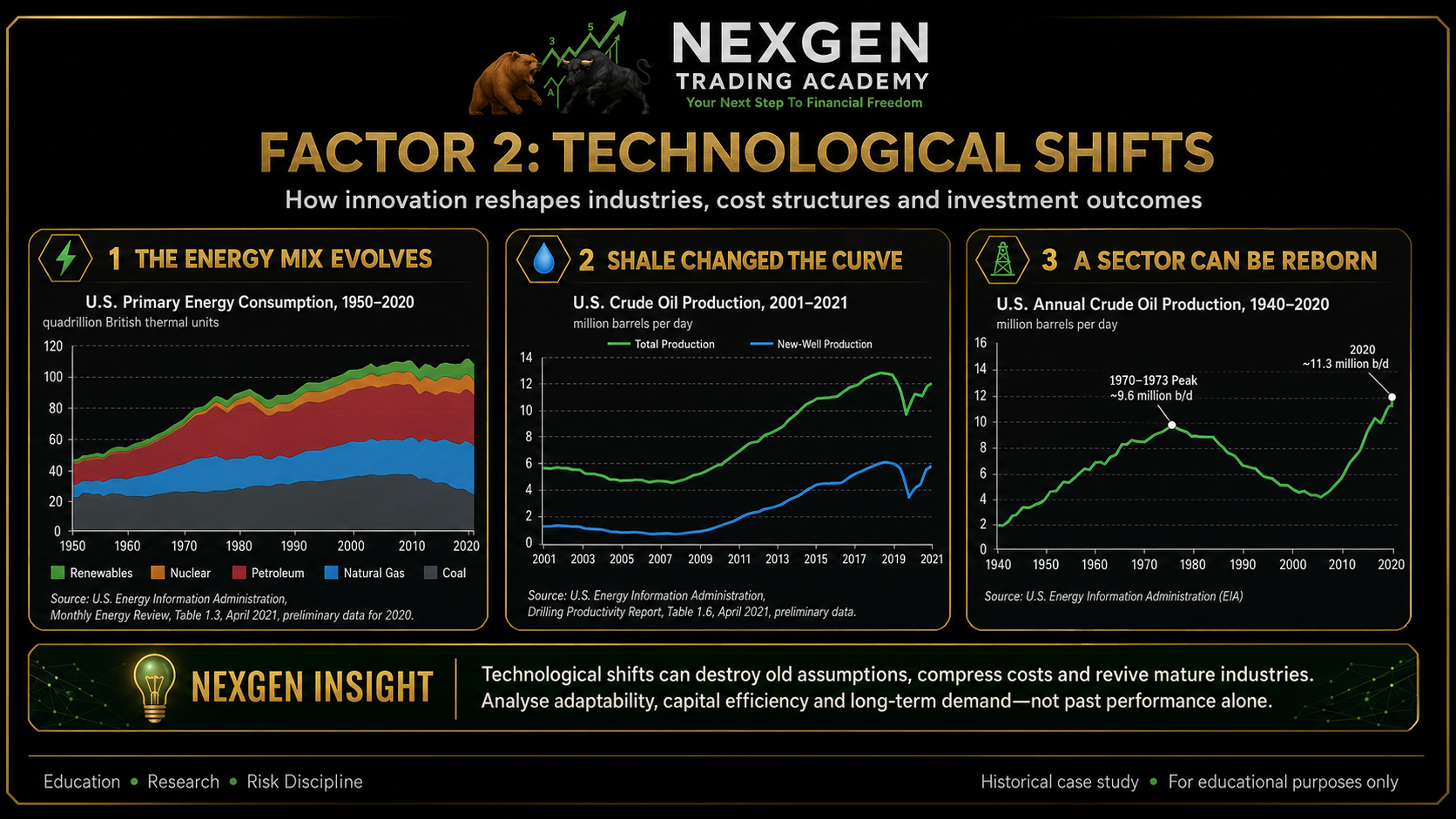
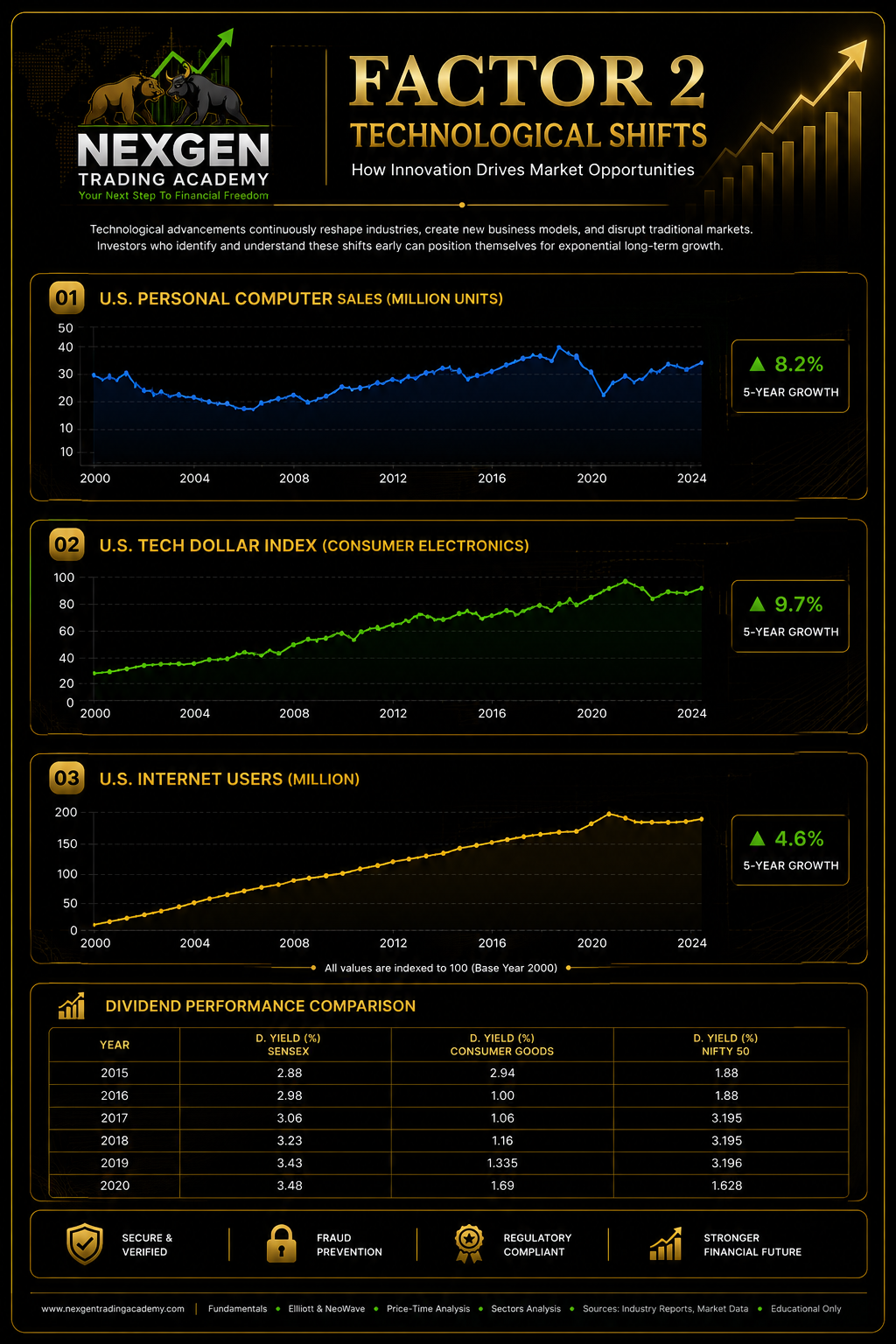
Technological progress has always been one of the strongest forces driving economic development. Throughout history, major innovations have transformed industries, improved productivity, reduced production costs, and created entirely new business opportunities. While these advancements contribute to long-term economic growth, they also reshape financial markets by changing the competitive landscape for businesses. Companies that successfully adapt to technological change often strengthen their market position, whereas those that fail to innovate risk losing relevance. For investors, understanding technological shifts is essential because innovation has the power to influence corporate earnings, industry leadership, and stock market performance over extended periods.Unlike short-term economic fluctuations, technological changes usually unfold gradually. New technologies are developed, tested, commercialized, and eventually adopted by consumers and businesses. During this transition, existing industries may experience significant disruption. Companies that once dominated their markets may lose their competitive advantage, while emerging businesses offering more efficient solutions may capture increasing market share. Investors who recognize these transformations early are often better positioned to identify future investment opportunities and manage potential risks.One of the most significant examples of technological transformation in recent decades has been the Shale Revolution in the United States. For many years, conventional crude oil production dominated the global energy market. However, advances in horizontal drilling and hydraulic fracturing technologies enabled energy companies to extract oil and natural gas from shale rock formations that were previously considered commercially unviable. This technological breakthrough dramatically increased energy production in the United States, reducing its dependence on imported crude oil and reshaping global energy markets.The increase in domestic energy production strengthened the United States' energy security while also influencing global oil supply. As production expanded, the balance of power within international energy markets gradually shifted. Countries that had traditionally dominated global oil exports faced increasing competition, resulting in changes to international trade patterns and commodity pricing. Investors observing these developments recognized that technological innovation was not merely affecting individual companies but was altering the economics of an entire industry.The shale revolution also demonstrated how technology can reduce production costs. Improved extraction methods made it possible to produce oil more efficiently, allowing companies to remain profitable even under changing market conditions. Businesses that adopted these innovations gained operational advantages over competitors relying on older production techniques. Investors increasingly rewarded companies capable of improving efficiency through technological advancement, while less adaptable businesses faced declining profitability and reduced market valuations.Technological shifts are not limited to the energy sector. The automobile industry provides another clear example of how innovation influences financial markets. For more than a century, vehicles powered by internal combustion engines dominated global transportation. In recent years, however, rapid progress in electric vehicle technology, battery development, renewable energy, and autonomous driving systems has begun transforming the industry. Traditional automobile manufacturers now compete alongside new entrants focused entirely on electric mobility. This transition has affected not only automobile manufacturers but also companies involved in battery production, charging infrastructure, semiconductor manufacturing, and renewable energy generation.Such developments illustrate that technological change often creates both winners and losers. Businesses that anticipate changing consumer preferences and invest in research, innovation, and product development are generally better positioned for long-term growth. Conversely, companies that delay adaptation may experience declining demand for their products, shrinking market share, and lower profitability. Investors therefore evaluate not only a company's current financial performance but also its ability to remain competitive in an evolving technological environment.The information technology sector provides another example of continuous technological transformation. Over the past two decades, businesses have increasingly shifted from traditional software models toward cloud computing, artificial intelligence, cybersecurity, data analytics, and software-as-a-service (SaaS) platforms. Companies that successfully embraced these innovations expanded rapidly, while businesses dependent on outdated technologies often struggled to maintain their competitive position. Investors closely monitor such transitions because technological leadership frequently translates into stronger long-term earnings growth.Technological advancement also influences productivity across the broader economy. Automation, digital communication, advanced manufacturing, robotics, and artificial intelligence enable businesses to produce more goods and services with fewer resources. Improved efficiency lowers production costs, enhances profitability, and increases overall economic output. As companies become more productive, they contribute to higher national income, stronger corporate earnings, and improved investor confidence.However, technological disruption also introduces uncertainty. New technologies often require significant investment before generating returns, and not every innovation achieves commercial success. Some companies invest heavily in technologies that fail to gain widespread adoption, resulting in financial losses. Investors must therefore distinguish between sustainable technological advancements and temporary market excitement. Careful analysis of a company's research capabilities, financial strength, management quality, and long-term strategy remains essential when evaluating businesses operating in rapidly evolving industries.Governments also play an important role in encouraging technological progress. Public investment in research, education, infrastructure, and innovation creates an environment in which new technologies can develop more rapidly. Regulatory policies, intellectual property protection, and financial incentives for research and development further support innovation across multiple sectors. Countries that successfully promote technological advancement often experience higher productivity, stronger industrial competitiveness, and greater long-term economic growth.From an investment perspective, technological shifts should not be viewed solely as opportunities for rapid profits. Instead, they represent long-term structural changes that gradually reshape industries and influence business performance over many years. Investors who understand these transformations are better equipped to identify companies capable of adapting to future market conditions while avoiding businesses whose competitive advantages may gradually disappear.It is equally important to recognize that technological innovation affects industries differently. Some sectors experience rapid disruption, while others evolve more gradually. Investors should therefore avoid assuming that every new technology will transform every industry at the same pace. Instead, they should evaluate how innovation specifically influences each company's products, operations, customers, and competitive position.In conclusion, technological change is one of the most powerful macroeconomic forces influencing businesses and financial markets. Innovations reshape industries, improve productivity, alter consumer behaviour, and create new investment opportunities while simultaneously challenging established business models. Investors who understand the long-term impact of technological transformation are better positioned to evaluate future growth prospects and make informed investment decisions. As technology continues to evolve, the ability to recognize meaningful structural changes will remain an essential skill for successful long-term investing.
Core Principle: Technological Shifts and Market Transformation
Core Concepts & Foundational Principles
Mastering technological shifts and market transformation builds lasting financial clarity, confidence, and disciplined execution.
Summary & Key Takeaways
Mastering technological shifts and market transformation is vital for developing sound financial and investment discipline..
Key Mechanics & Frameworks
Consistent long-term habits create significantly greater wealth than short-term speculative decisions..
Continuous study and structured application of Macroeconomic Indicators and Their Impact on Stock Markets Understanding How Economic Forces Shape Investment Decisions empowers smart decision-making..
Summary & Key Takeaways
- Consistent long-term habits create significantly greater wealth than short-term speculative decisions.
- Mastering technological shifts and market transformation is vital for developing sound financial and investment discipline.
- Summary & Key Takeaways.