Bonus Issue
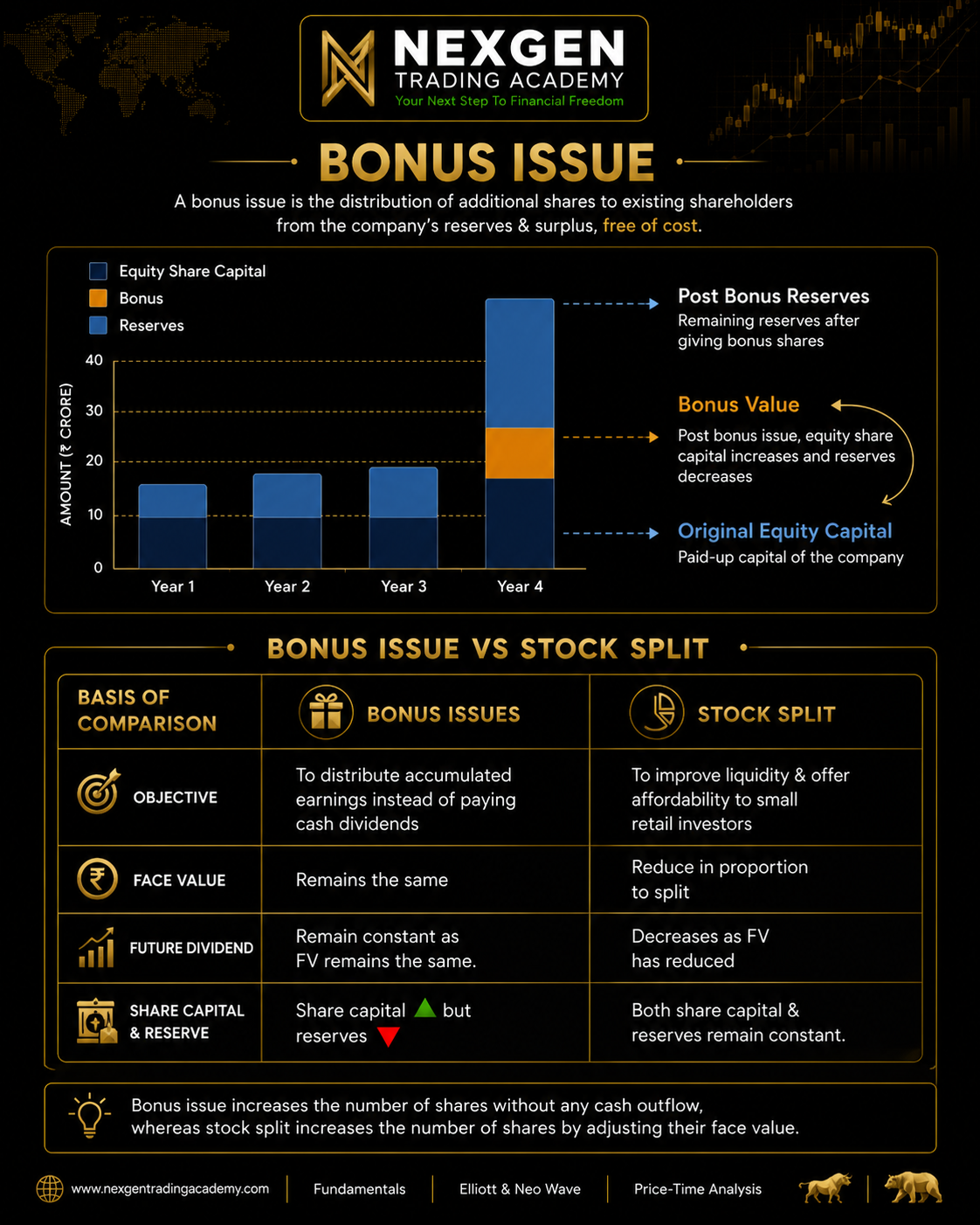
Bonus IssueA company may choose to reward its shareholders in different ways. While dividends provide cash distributions from profits, there are situations where a company prefers to retain its cash for future business requirements while still rewarding its investors. In such cases, the company may issue additional shares to its existing shareholders without asking them to pay any additional amount. This corporate action is known as a Bonus Issue. Although shareholders receive more shares, the company's total value remains unchanged immediately after the issue. Understanding how bonus issues work is important because they influence the number of shares outstanding, market price, financial ratios, and investor perception without altering the underlying value of the business.A Bonus Issue is a corporate action through which a company issues additional fully paid-up shares to its existing shareholders free of cost. These additional shares are allotted in proportion to the number of shares already held by each shareholder. Instead of distributing cash dividends, the company converts a portion of its accumulated reserves or retained earnings into share capital and distributes these new shares among existing shareholders.Unlike a rights issue, where shareholders must purchase additional shares, a bonus issue requires no payment from investors. Eligible shareholders automatically receive the bonus shares based on the announced bonus ratio. As a result, the ownership percentage of every shareholder remains unchanged because all eligible shareholders receive additional shares in the same proportion.One of the primary reasons companies announce a bonus issue is to reward shareholders without reducing cash reserves. A company may have accumulated significant retained earnings over several years but prefer to conserve cash for future expansion, research and development, debt repayment, or other business activities. Rather than distributing cash dividends, management may capitalize these reserves by issuing bonus shares, thereby rewarding shareholders while preserving liquidity.Another important objective is to increase the number of outstanding shares and improve market liquidity. As successful companies grow, their share prices often rise considerably, making them less affordable for smaller investors. A bonus issue increases the total number of shares available in the market while proportionately reducing the market price per share. This improved affordability often encourages greater investor participation and enhances trading activity.A bonus issue also reflects management's confidence in the company's future prospects. Since bonus shares are issued from accumulated reserves generated through profitable operations, companies generally undertake bonus issues when they possess strong financial performance and sufficient reserves. Investors often interpret bonus announcements as a signal that management expects continued business growth and sustainable profitability. However, a bonus issue should never be viewed as a guarantee of future earnings because it does not directly improve the company's operational performance.The number of bonus shares distributed is determined according to a bonus ratio. This ratio specifies how many additional shares shareholders will receive for every existing share they own. For example, if a company announces a 1:1 bonus issue, every shareholder receives one additional share for each share already held. An investor owning 100 shares before the bonus issue will therefore own 200 shares after the allotment. Similarly, a 2:1 bonus issue provides two additional shares for every one existing share held by eligible shareholders.Although shareholders receive additional shares, it is important to understand that a bonus issue does not increase shareholder wealth immediately. Since the number of outstanding shares increases, the market price of each share adjusts downward proportionately. For example, if a company trading at ₹1,000 per share announces a 1:1 bonus issue, the post-bonus share price may adjust to approximately ₹500 per share. The investor now owns twice as many shares, but the total market value of the investment remains broadly unchanged immediately after the adjustment.A bonus issue is financed through the company's accumulated reserves and surplus rather than fresh capital from investors. Instead of introducing new funds into the business, the company transfers a portion of its retained earnings into share capital. Consequently, the company's total shareholders' equity remains unchanged because only the composition of equity changes. Reserves decrease while paid-up share capital increases by an equivalent amount.The implementation of a bonus issue involves several important dates. The company first announces the proposal through stock exchanges and regulatory filings after obtaining approval from the Board of Directors and, where required, shareholders. One of the most important dates is the Record Date, which determines the shareholders eligible to receive the bonus shares. Investors whose names appear in the company's shareholder records on the Record Date automatically qualify for the allotment.Closely associated with the Record Date is the Ex-Bonus Date. Investors purchasing shares on or after the Ex-Bonus Date generally do not become eligible for the announced bonus issue because ownership transfer is not completed before the Record Date. Following the allotment process, the bonus shares are credited electronically to the shareholders' Demat Accounts, increasing the number of shares they own.A bonus issue also influences several important financial ratios. Since the total number of outstanding shares increases while the company's total earnings remain unchanged, Earnings Per Share (EPS) decreases proportionately. This reduction should not be interpreted as weaker profitability because the company's actual earnings remain the same. The change simply reflects the increased number of shares used in the EPS calculation.Similarly, Book Value Per Share (BVPS) also declines because the company's total net worth is now distributed across a larger number of shares. Once again, this represents an accounting adjustment rather than a reduction in the company's intrinsic value. Investors should therefore compare adjusted financial ratios when analysing company performance after a bonus issue.It is important to distinguish between a Bonus Issue and a Stock Split, as these corporate actions often appear similar but differ fundamentally. In a stock split, the company reduces the face value of existing shares, increasing the number of shares without altering the share capital. In contrast, a bonus issue increases the paid-up share capital by converting reserves into equity and issuing additional fully paid-up shares. Although both actions increase the number of shares and reduce the market price per share, their accounting treatment and financial implications differ significantly.Bonus issues also differ from cash dividends. A dividend provides shareholders with immediate cash income, allowing them to use or reinvest the money as they choose. A bonus issue, however, provides additional shares instead of cash. Shareholders do not receive immediate liquidity, but they own a larger number of shares representing the same proportionate ownership in the company.From an investor's perspective, a bonus issue should not be interpreted solely as an opportunity for immediate profit. While additional shares may appear attractive, the investor's total wealth remains broadly unchanged immediately after the issue because the market price adjusts proportionately. Long-term investment returns continue to depend on the company's ability to generate higher earnings, expand its operations, and improve profitability over time.Investors should also evaluate the financial strength of the company before interpreting a bonus announcement positively. A company capable of issuing bonus shares generally possesses substantial retained earnings, but this alone does not guarantee future business success. Factors such as management quality, competitive advantages, cash flow generation, industry outlook, and long-term growth opportunities remain equally important when assessing investment quality.For long-term shareholders, bonus issues often increase the number of shares available for future capital appreciation and dividend distributions. If the company continues to grow successfully, the additional shares received through the bonus issue may contribute to greater long-term wealth creation. However, this outcome depends entirely on the company's future business performance rather than the bonus issue itself.Ultimately, a bonus issue represents an accounting reallocation of shareholders' equity rather than the creation of new economic value. Investors who understand this distinction are less likely to confuse an increase in the number of shares with an increase in investment value. Sound investment decisions should continue to focus on the company's business fundamentals rather than the mechanics of the corporate action.In conclusion, a Bonus Issue is an important corporate action through which a company rewards existing shareholders by issuing additional fully paid-up shares without requiring any payment. Bonus issues improve share affordability, enhance market liquidity, and demonstrate management's confidence in the company's financial position while preserving cash resources for future growth. Although shareholders receive additional shares, the company's intrinsic value and the investor's immediate wealth remain unchanged. Understanding the objectives, mechanics, and financial implications of bonus issues enables investors to evaluate these corporate actions correctly and make informed long-term investment decisions based on the company's underlying business performance rather than changes in share quantity.
Mastering bonus issue builds lasting financial clarity, confidence, and disciplined execution.
Core Concepts & Foundational Principles
Summary & Key Takeaways
Mastering bonus issue is vital for developing sound financial and investment discipline..
Core Principle: Bonus Issue
Key Mechanics & Frameworks
Consistent long-term habits create significantly greater wealth than short-term speculative decisions..
Continuous study and structured application of Corporate Actions Understanding Dividends, Bonus Shares, Stock Splits, Buybacks, Rights Issues, and Their Impact on Investors empowers smart decision-making..
Summary & Key Takeaways
- Consistent long-term habits create significantly greater wealth than short-term speculative decisions.
- Mastering bonus issue is vital for developing sound financial and investment discipline.
- Summary & Key Takeaways.