Mergers and Acquisition (M&A)
Mergers and Acquisition (M&A)Business growth can be achieved in many ways. Some companies expand gradually by increasing production capacity, launching new products, entering new markets, or investing in research and development. Others choose a faster route by combining with existing businesses or acquiring companies that already possess valuable resources, technology, customer relationships, or market share. These strategic business combinations are known as Mergers and Acquisitions (M&A). Mergers and acquisitions play a significant role in corporate strategy because they enable companies to strengthen their competitive position, improve operational efficiency, and accelerate long-term growth. For investors, understanding M&A is essential because such corporate actions often have a substantial impact on share prices, financial performance, and shareholder value.A Merger is a corporate action in which two or more companies combine to form a single business entity. Instead of operating as separate organizations, the merging companies integrate their assets, liabilities, employees, operations, and management into one organization. Depending on the structure of the transaction, one company may continue to exist while the other ceases to operate independently, or both companies may combine to create an entirely new business entity. The primary objective of a merger is to create greater value than the individual companies could achieve independently.An Acquisition, on the other hand, occurs when one company purchases another company and obtains control over its business operations. The acquiring company may purchase a majority of the target company's shares or acquire its assets directly. Unlike a merger, an acquisition usually does not result in the creation of a new company. Instead, the acquired company becomes part of the acquiring organization's corporate structure while continuing to operate either under its existing brand or under the acquiring company's identity.Although mergers and acquisitions are often discussed together, they differ in their structure. A merger generally involves two companies joining together with mutual agreement to form a unified organization, whereas an acquisition typically involves one company purchasing another and assuming control of its operations. Regardless of the structure, both transactions are designed to improve business performance and create long-term shareholder value.One of the most common reasons companies pursue mergers and acquisitions is business expansion. Entering a new geographical market or industry independently often requires considerable time, investment, and regulatory approvals. By acquiring an existing company, a business gains immediate access to established customers, distribution networks, production facilities, and local market knowledge. This allows companies to expand more rapidly than through internal growth alone.Another important objective is achieving economies of scale. Larger organizations often benefit from lower operating costs because administrative expenses, manufacturing costs, marketing expenditures, and procurement activities can be spread across a larger volume of business. After a successful merger, the combined organization may eliminate duplicate functions, optimize production processes, and negotiate more favourable terms with suppliers, thereby improving overall profitability.Companies also undertake mergers and acquisitions to acquire new technologies, intellectual property, or specialized expertise. In industries such as technology, pharmaceuticals, renewable energy, and telecommunications, innovation often determines long-term competitiveness. Rather than developing new capabilities internally over many years, companies may acquire businesses that already possess advanced technologies, patents, research expertise, or highly skilled professionals. Such acquisitions accelerate innovation while strengthening the acquiring company's competitive position.Another strategic motivation is market share expansion. Acquiring a competitor enables a company to increase its customer base, strengthen its presence within the industry, and improve its bargaining power with suppliers and distributors. By combining operations, companies may also reduce competition, improve pricing efficiency, and increase operational scale. However, such transactions are carefully reviewed by regulatory authorities to ensure they do not reduce market competition unfairly.Diversification is another important reason for mergers and acquisitions. Companies sometimes expand into unrelated industries to reduce dependence on a single source of revenue. By operating across multiple sectors, businesses may reduce overall risk because adverse conditions affecting one industry may be offset by stronger performance in another. Diversification enables companies to build more resilient business models capable of adapting to changing economic conditions.Mergers are commonly classified into different categories based on the relationship between the participating companies.A Horizontal Merger occurs when two companies operating within the same industry combine. For example, two automobile manufacturers or two banking institutions may merge to increase market share, reduce competition, and improve operational efficiency. Horizontal mergers often create larger organizations capable of competing more effectively in both domestic and international markets.A Vertical Merger involves companies operating at different stages of the same supply chain. For instance, a manufacturing company may merge with a supplier of raw materials or a distribution business. Vertical integration improves coordination between production and distribution while reducing dependence on external suppliers. Such mergers often enhance operational efficiency and reduce production costs.A Conglomerate Merger occurs when companies operating in completely unrelated industries combine. The objective of such mergers is generally diversification rather than operational integration. Although conglomerate mergers reduce concentration risk by creating multiple revenue streams, they also require effective management capable of overseeing diverse business activities.The announcement of a merger or acquisition often has a significant influence on share prices. Investors closely evaluate whether the proposed transaction is likely to increase future profitability, improve efficiency, strengthen market position, or create long-term shareholder value. If the market believes that the merger or acquisition will generate sustainable benefits, the share prices of one or both companies may increase. Conversely, concerns regarding excessive acquisition costs, integration challenges, or increased financial risk may lead to negative market reactions.One of the greatest challenges associated with mergers and acquisitions is business integration. Combining two organizations involves much more than transferring ownership. Management must integrate employees, corporate culture, technology systems, production facilities, financial reporting processes, customer relationships, and operational procedures. Even strategically attractive transactions may fail to achieve expected benefits if integration is poorly managed. Investors should therefore evaluate management's ability to execute the integration process effectively.Financing also plays a critical role in acquisitions. Companies may fund acquisitions using internal cash reserves, bank borrowings, the issuance of new shares, or a combination of these methods. The financing structure influences the company's future debt levels, profitability, financial flexibility, and capital structure. Investors should assess whether the proposed financing approach supports sustainable growth or places excessive financial pressure on the acquiring company.Regulatory approval is another essential component of large mergers and acquisitions. Competition authorities examine whether the proposed transaction may reduce market competition, create monopolistic conditions, or adversely affect consumers. Regulatory approval helps maintain fair competition while protecting the interests of both investors and the public.Although mergers and acquisitions offer significant growth opportunities, they also involve considerable risks. Overestimating expected cost savings, paying excessively high acquisition prices, underestimating integration challenges, or experiencing cultural conflicts between organizations may prevent the combined company from achieving its intended objectives. Investors should therefore evaluate each transaction carefully rather than assuming that every merger automatically creates shareholder value.For long-term investors, mergers and acquisitions should be analysed within the broader context of the company's strategic vision. Successful transactions generally strengthen competitive advantages, improve operational efficiency, expand market opportunities, and enhance long-term profitability. However, poor strategic planning or ineffective execution may reduce shareholder returns despite the initial market enthusiasm.Ultimately, mergers and acquisitions represent powerful strategic tools that companies use to achieve sustainable growth, improve competitiveness, and strengthen their market position. Investors who understand the objectives, benefits, challenges, and financial implications of these corporate actions are better equipped to evaluate company announcements objectively and make informed investment decisions based on long-term business fundamentals rather than short-term market reactions.In conclusion, Mergers and Acquisition (M&A) are important corporate actions that enable companies to combine resources, expand operations, acquire new capabilities, improve efficiency, and create long-term shareholder value. While these transactions have the potential to transform businesses and strengthen competitive advantages, their success depends on careful planning, sound financial management, effective integration, and strong leadership. By understanding the purpose and implications of mergers and acquisitions, investors can better interpret these corporate actions and assess their significance within the broader framework of corporate growth and investment analysis.
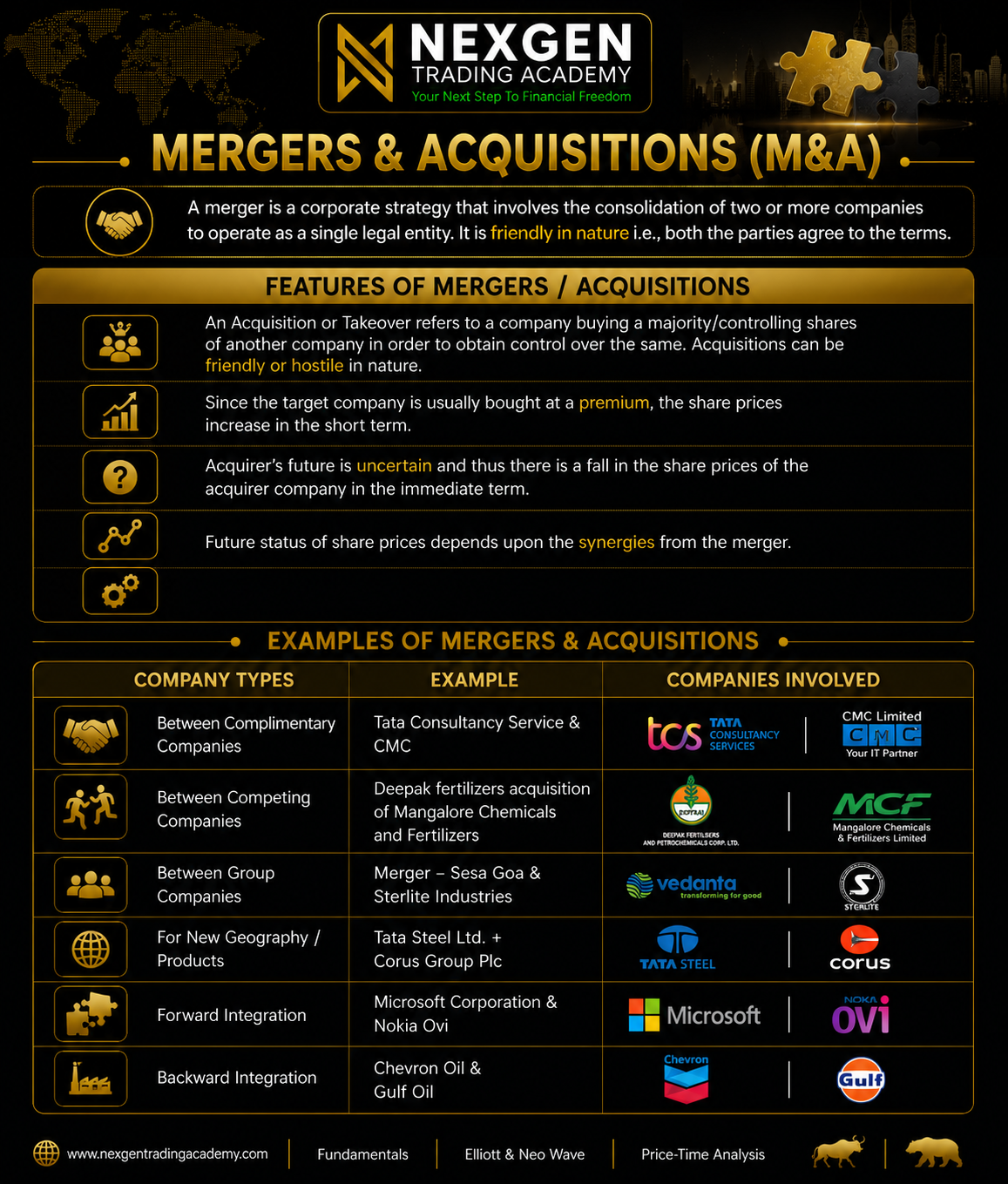
Mastering mergers and acquisition (m&a) builds lasting financial clarity, confidence, and disciplined execution.
Core Concepts & Foundational Principles
Summary & Key Takeaways
Mastering mergers and acquisition (m&a) is vital for developing sound financial and investment discipline..
Core Principle: Mergers and Acquisition (M&A)
Key Mechanics & Frameworks
Consistent long-term habits create significantly greater wealth than short-term speculative decisions..
Continuous study and structured application of Corporate Actions Understanding Dividends, Bonus Shares, Stock Splits, Buybacks, Rights Issues, and Their Impact on Investors empowers smart decision-making..
Summary & Key Takeaways
- Consistent long-term habits create significantly greater wealth than short-term speculative decisions.
- Mastering mergers and acquisition (m&a) is vital for developing sound financial and investment discipline.
- Summary & Key Takeaways.