What are Dividends?
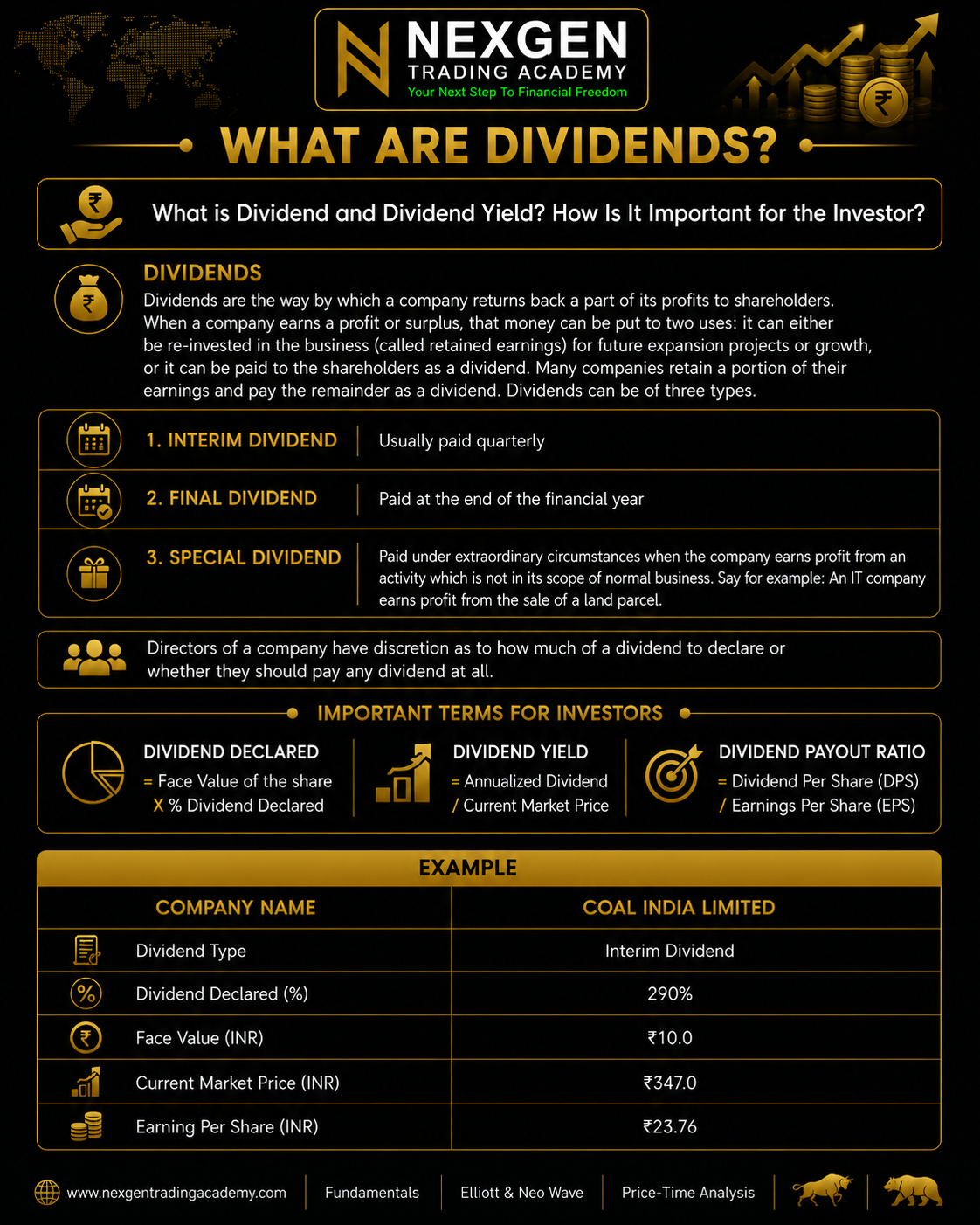
What are Dividends?A company's success is ultimately measured by its ability to generate sustainable profits and create value for its shareholders. Once a business earns profits, the management must decide how those earnings should be utilized. A portion of the profits may be reinvested into the business to finance future growth, while another portion may be distributed among shareholders as a reward for their investment. This distribution of profits is known as a dividend. Dividends represent one of the most visible ways in which companies share their financial success with their owners, making them an important concept for every stock market investor to understand.A dividend is the portion of a company's profits that is distributed to its shareholders. It serves as a financial reward for investors who have provided capital by purchasing the company's shares. Unlike capital gains, which depend on changes in the market price of a stock, dividends provide shareholders with a direct cash return without requiring them to sell their investment. As a result, dividends are often viewed as a source of regular income, particularly by long-term investors seeking stable returns.It is important to understand that not every profitable company pays dividends. The decision to declare a dividend depends entirely on the company's financial position, future expansion plans, cash flow requirements, and long-term business strategy. A rapidly growing company may choose to retain its profits and reinvest them into expanding operations, developing new products, acquiring technology, or entering new markets. In contrast, a mature company with stable earnings and limited expansion requirements may regularly distribute a portion of its profits to shareholders through dividends.The authority to recommend a dividend generally rests with the company's Board of Directors. After reviewing the company's financial performance, profitability, cash reserves, future investment requirements, and overall business outlook, the Board may propose a dividend. Depending on the applicable corporate laws and the company's Articles of Association, the proposed dividend may also require approval from shareholders during the Annual General Meeting before it is distributed.Dividends are most commonly paid in the form of cash, which is directly credited to the eligible shareholder's registered bank account. This is known as a cash dividend and represents the most widely used method of profit distribution. However, companies may also reward shareholders through stock dividends, commonly referred to as bonus shares, where additional shares are issued instead of cash. While bonus shares increase the number of shares held by investors, they do not provide immediate cash income.Companies generally declare dividends after evaluating their earnings and cash flow. Profitability alone does not guarantee the payment of dividends because the company must also possess sufficient cash resources to make the distribution. A business may report strong accounting profits but still retain earnings if substantial capital expenditure or debt repayment obligations exist. Therefore, sustainable cash flow is an essential consideration before declaring dividends.One of the most important aspects of dividend investing is understanding the key dates associated with dividend payments. These dates determine shareholder eligibility and the timing of the dividend distribution.The first is the Declaration Date, on which the company officially announces its intention to pay a dividend. This announcement includes the dividend amount, Record Date, Ex-Dividend Date, and Payment Date. Once declared, the information becomes publicly available through stock exchanges and regulatory disclosures.The second important date is the Record Date. This is the date on which the company determines the list of shareholders who are eligible to receive the dividend. Investors whose names appear in the company's shareholder records on the Record Date qualify for the dividend payment.Closely related to the Record Date is the Ex-Dividend Date. Investors purchasing shares on or after the Ex-Dividend Date generally do not become eligible for the upcoming dividend because ownership transfer will not be completed before the Record Date. Consequently, investors wishing to receive the declared dividend must purchase the shares before the Ex-Dividend Date.The final stage is the Payment Date, when the company actually distributes the dividend to eligible shareholders. Cash dividends are generally credited electronically to the shareholder's registered bank account, completing the dividend payment process.Companies may declare different types of dividends depending on their financial performance and timing. An Interim Dividend is declared during the financial year before the preparation of the annual financial statements. Companies generally announce interim dividends when business performance remains strong throughout the year and management wishes to reward shareholders without waiting for the financial year-end.In contrast, a Final Dividend is declared after the financial year has concluded and the company's audited financial statements have been prepared. Final dividends are usually recommended by the Board of Directors and approved by shareholders before payment.Some companies may also declare a Special Dividend. Unlike regular dividends, a special dividend is typically a one-time payment resulting from exceptional profits, the sale of major business assets, or other extraordinary financial events. Since special dividends depend on unusual circumstances, investors should not expect them to occur regularly.Dividend payments provide several benefits to investors. One of the most important advantages is the generation of regular income. Retired individuals and conservative investors often prefer dividend-paying companies because dividends provide periodic cash flows while allowing them to continue holding their investments. Regular dividend income can also be reinvested to purchase additional shares, contributing to long-term wealth creation through compounding.Dividends also serve as an indicator of a company's financial stability. Businesses that consistently generate sufficient profits and cash flow over long periods are generally better positioned to maintain regular dividend payments. Although dividend history alone should never determine an investment decision, companies with stable dividend records often demonstrate disciplined financial management and consistent profitability.However, investors should avoid assuming that higher dividends always indicate a better investment. A company distributing a large proportion of its profits as dividends may have limited opportunities for future expansion. Conversely, businesses retaining a significant portion of their earnings may generate higher long-term returns by reinvesting profits into productive growth opportunities. Therefore, dividend policy should always be evaluated within the context of the company's overall business strategy and growth prospects.Another common misconception is that a dividend payment creates additional wealth without affecting the company's value. In reality, when a company distributes cash to shareholders, its cash reserves decline by the amount of the dividend paid. Consequently, the share price often adjusts downward by approximately the dividend amount on the Ex-Dividend Date. Although investors receive cash, the company's assets are correspondingly reduced, leaving the overall value broadly unchanged immediately after the distribution.Investors should also understand the concept of the Dividend Payout Ratio, which measures the proportion of a company's net earnings distributed as dividends. A lower payout ratio often indicates that the company retains a larger share of its profits for future growth, while a higher payout ratio suggests greater emphasis on shareholder distributions. Neither approach is inherently superior; the appropriate policy depends on the company's industry, growth stage, and financial objectives.Successful dividend investing requires balancing income generation with long-term growth potential. Investors should evaluate the sustainability of dividend payments by analysing earnings growth, cash flow, debt levels, capital expenditure requirements, and management's capital allocation strategy. A consistently growing business with a moderate but sustainable dividend policy may often provide greater long-term value than a company offering unusually high dividends without strong underlying financial performance.In conclusion, dividends represent an important mechanism through which companies share their profits with shareholders. They provide investors with regular income, reflect management's capital allocation decisions, and often signal financial stability. However, dividends should never be analysed in isolation. Investors must consider the company's profitability, growth opportunities, cash flow, and long-term strategy before evaluating the significance of any dividend announcement. A clear understanding of dividends enables investors to make more informed investment decisions and appreciate the broader relationship between corporate profitability and shareholder returns.
Mastering what are dividends? builds lasting financial clarity, confidence, and disciplined execution.
Core Concepts & Foundational Principles
Summary & Key Takeaways
Mastering what are dividends? is vital for developing sound financial and investment discipline..
Core Principle: What are Dividends?
Key Mechanics & Frameworks
Consistent long-term habits create significantly greater wealth than short-term speculative decisions..
Continuous study and structured application of Corporate Actions Understanding Dividends, Bonus Shares, Stock Splits, Buybacks, Rights Issues, and Their Impact on Investors empowers smart decision-making..
Summary & Key Takeaways
- Consistent long-term habits create significantly greater wealth than short-term speculative decisions.
- Mastering what are dividends? is vital for developing sound financial and investment discipline.
- Summary & Key Takeaways.