Investing in Dividend Paying Stocks
Dividend-paying stocks have long been regarded as an important component of long-term investment portfolios. While many investors focus primarily on capital appreciation through rising share prices, dividends offer an additional source of return by providing regular cash income. For individuals seeking stability, consistent returns, or passive income, investing in companies with a strong history of dividend payments can be an attractive strategy. However, selecting dividend-paying stocks requires more than simply choosing companies that distribute the highest dividends. Investors must evaluate the sustainability of dividend payments, the financial strength of the company, and its long-term growth prospects before making investment decisions.A dividend-paying stock is the share of a company that regularly distributes a portion of its profits to shareholders in the form of dividends. These companies generally generate stable earnings and sufficient cash flows to reward investors while continuing to operate and expand their businesses. Dividend-paying companies are often well-established organizations with mature business models, predictable revenues, and disciplined financial management.One of the primary reasons investors choose dividend-paying stocks is the opportunity to generate regular income. Unlike capital gains, which depend on selling shares at a higher price, dividends provide cash payments while allowing investors to continue owning the stock. This characteristic makes dividend-paying companies particularly attractive to retirees, conservative investors, and individuals seeking a steady stream of passive income from their investments.Another important advantage of dividend investing is the power of compounding. Investors who reinvest their dividends by purchasing additional shares gradually increase their ownership in the company. Over time, these additional shares generate further dividends, creating a compounding effect that can significantly enhance long-term wealth. Although individual dividend payments may appear modest, consistent reinvestment over many years can contribute substantially to portfolio growth.Dividend-paying companies are often associated with financial stability. Businesses capable of distributing profits consistently generally possess strong cash flows, sound management, established market positions, and sustainable business operations. While dividend payments do not guarantee future success, companies with a long history of maintaining or gradually increasing dividends often demonstrate disciplined capital allocation and prudent financial management.Despite these advantages, investors should understand that not all dividend-paying companies are equally attractive. One of the most common mistakes made by beginners is selecting stocks solely because they offer unusually high dividend yields. A high dividend yield may sometimes result from a sharp decline in the company's share price rather than an improvement in its financial performance. In certain cases, an exceptionally high dividend yield may indicate financial difficulties or concerns regarding the sustainability of future dividend payments.Therefore, investors should evaluate the Dividend Yield carefully. Dividend Yield measures the annual dividend received relative to the current market price of the share. While it provides useful information regarding the income generated by an investment, it should never be considered in isolation. A moderate and consistently growing dividend yield is often more desirable than an unusually high yield that may not be sustainable over the long term.Another important measure is the Dividend Payout Ratio, which indicates the proportion of the company's net earnings distributed as dividends. A company paying nearly all of its profits as dividends may have limited resources available for future expansion, research, debt reduction, or business development. Conversely, a company retaining an appropriate portion of its earnings while maintaining regular dividend payments often demonstrates a balanced approach to rewarding shareholders and supporting future growth.Investors should also examine the company's earnings consistency before investing in dividend-paying stocks. Sustainable dividends depend on stable and growing profits. Companies experiencing declining earnings may eventually reduce or suspend dividend payments if financial conditions deteriorate. Reviewing several years of financial statements allows investors to determine whether dividend payments are supported by genuine business performance rather than temporary financial circumstances.Strong cash flow is equally important. Since dividends are paid using cash rather than accounting profits alone, companies must generate sufficient operating cash flows to maintain their dividend policy. Businesses reporting high profits but weak cash generation may encounter difficulties sustaining future dividend payments. Investors should therefore analyse both profitability and cash flow before evaluating dividend-paying companies.The level of debt carried by the company also influences dividend sustainability. Businesses with excessive debt obligations must allocate a significant portion of their cash flows toward interest payments and loan repayments. During periods of financial stress, highly leveraged companies may reduce or suspend dividends to preserve cash. Investors generally prefer companies maintaining a healthy balance between debt and equity while generating sufficient cash to support both business operations and shareholder distributions.Another important consideration is the company's dividend history. Businesses that have consistently paid or gradually increased dividends over many years often demonstrate financial discipline and stable earnings. Although past performance does not guarantee future results, a long record of reliable dividend payments indicates management's commitment to rewarding shareholders while maintaining financial stability.Industry characteristics also play an important role in dividend investing. Mature industries such as banking, consumer goods, utilities, pharmaceuticals, and certain manufacturing businesses often generate predictable cash flows, making regular dividend payments more common. In contrast, rapidly growing technology companies or emerging businesses may retain most of their profits to finance future expansion instead of distributing dividends. Neither approach is inherently superior; the appropriate investment depends on the investor's financial objectives.Investors should avoid assuming that companies not paying dividends are poor investments. Many highly successful businesses reinvest their earnings into research, technology, acquisitions, and expansion, generating significant long-term capital appreciation for shareholders. Younger companies operating in high-growth industries frequently prioritize business expansion over dividend distribution because reinvested profits may produce higher future returns than immediate cash payments.A balanced investment portfolio often includes a combination of growth stocks and dividend-paying stocks. Growth-oriented companies provide the potential for substantial capital appreciation, while dividend-paying companies contribute stability and regular income. Combining both approaches allows investors to benefit from long-term business growth while generating periodic cash flows that may be reinvested or used to meet financial needs.Taxation is another factor investors should consider when evaluating dividend-paying stocks. Since dividend income is generally subject to applicable tax regulations, investors should assess the after-tax return rather than focusing solely on the declared dividend amount. Understanding the prevailing tax framework helps investors evaluate the true financial benefit of dividend investing.Perhaps the most important principle in dividend investing is to focus on business quality rather than dividend size alone. A financially strong company with moderate but sustainable dividends often represents a better long-term investment than a financially weak company offering unusually high dividend payments. Investors should evaluate management quality, competitive position, profitability, cash flow, debt levels, and future growth opportunities alongside dividend policy before making investment decisions.Long-term investors often benefit from remaining patient and allowing dividend-paying investments to compound over many years. Regular reinvestment of dividends, combined with gradual business growth, has historically contributed to substantial wealth creation. This disciplined approach emphasizes consistency rather than attempting to maximize short-term income through excessively high-yield investments.In conclusion, investing in dividend-paying stocks provides investors with an opportunity to generate regular income while participating in the long-term growth of financially stable companies. Sustainable dividends often reflect strong cash flows, disciplined management, and sound business fundamentals. However, successful dividend investing requires careful evaluation of dividend yield, payout ratio, earnings quality, cash flow, debt levels, and long-term business prospects. By focusing on financially healthy companies rather than simply the highest dividend payments, investors can build a balanced portfolio that supports both income generation and long-term wealth creation.
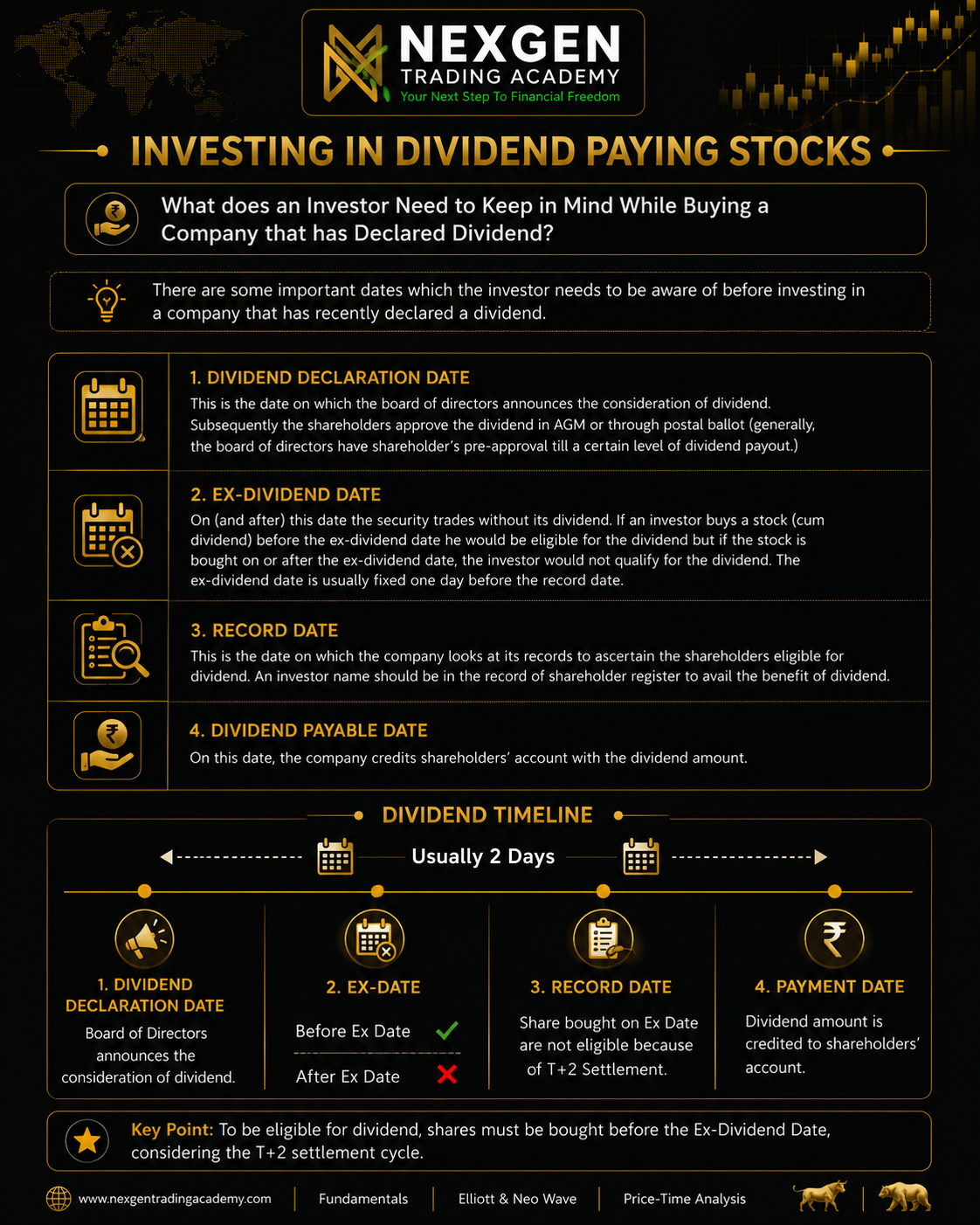
Core Principle: Investing in Dividend Paying Stocks
Core Concepts & Foundational Principles
Mastering investing in dividend paying stocks builds lasting financial clarity, confidence, and disciplined execution.
Summary & Key Takeaways
Mastering investing in dividend paying stocks is vital for developing sound financial and investment discipline..
Key Mechanics & Frameworks
Consistent long-term habits create significantly greater wealth than short-term speculative decisions..
Continuous study and structured application of Corporate Actions Understanding Dividends, Bonus Shares, Stock Splits, Buybacks, Rights Issues, and Their Impact on Investors empowers smart decision-making..
Summary & Key Takeaways
- Consistent long-term habits create significantly greater wealth than short-term speculative decisions.
- Mastering investing in dividend paying stocks is vital for developing sound financial and investment discipline.
- Summary & Key Takeaways.