Bottom-Up Approach for Stock Investing
The stock market offers investors thousands of opportunities across different industries and sectors. While some investors begin their research by analysing the overall economy and identifying promising industries, others follow an entirely different philosophy. Instead of allowing macroeconomic conditions to determine their investment decisions, they focus directly on identifying outstanding businesses capable of generating sustainable long-term returns regardless of temporary economic fluctuations. This investment methodology is known as the Bottom-Up Approach for Stock Investing. It emphasizes the quality of individual companies rather than the condition of the overall economy and has been successfully applied by many of the world's most respected long-term investors.The Bottom-Up Approach is an investment strategy that begins with analysing individual companies before considering industry or macroeconomic factors. Investors following this approach believe that exceptional businesses can create long-term shareholder value even when broader economic conditions are uncertain or temporarily unfavourable. Instead of asking which industries are likely to perform well during the current economic cycle, Bottom-Up investors ask a different question: Is this a fundamentally strong business capable of generating sustainable earnings over many years?The philosophy behind the Bottom-Up Approach is based on the belief that the long-term success of an investment depends primarily on the quality of the company rather than the short-term direction of the economy. Although macroeconomic conditions undoubtedly influence corporate performance, businesses with durable competitive advantages, capable management, strong financial discipline, and resilient business models often continue creating value across different phases of the economic cycle. Investors who adopt this approach focus their attention on identifying such companies rather than attempting to predict economic trends.The Bottom-Up Approach begins with an in-depth study of the company itself. Investors first seek to understand the nature of the business before analysing any financial information. They examine the products or services offered by the company, the problems those products solve, the target customers, the sources of revenue, and the factors that contribute to long-term profitability. A business that operates within a simple and understandable model is generally easier to evaluate than one that depends upon highly complex or rapidly changing conditions.Understanding the business model is particularly important because it helps investors determine whether the company's earnings are sustainable. Companies generating consistent revenue from products or services that satisfy long-term customer needs generally possess greater stability than businesses dependent on temporary market trends or unpredictable consumer behaviour. Investors therefore prefer companies whose operations can be understood clearly and whose future demand appears reasonably predictable.Once the business model has been understood, investors carefully evaluate the company's competitive advantages. Businesses rarely succeed over long periods unless they possess characteristics that distinguish them from competitors. These competitive advantages, often described as economic moats, allow companies to maintain profitability, attract loyal customers, and protect their market position despite increasing competition.Competitive advantages may arise from strong brand recognition, proprietary technology, patents, efficient production processes, extensive distribution networks, customer loyalty, intellectual property, cost leadership, or network effects. Companies possessing durable competitive advantages are often able to maintain pricing power, generate stable earnings, and withstand competitive pressure over many years. Investors following the Bottom-Up Approach devote significant attention to identifying businesses with these long-lasting strengths.Management quality represents another essential component of company analysis. Even businesses operating within attractive industries may underperform if management allocates capital inefficiently or pursues unsustainable growth strategies. Investors therefore examine whether management demonstrates integrity, competence, transparency, and long-term thinking. Annual reports, shareholder communications, corporate governance practices, and historical business decisions provide valuable insight into management's ability to create shareholder value.One of the defining characteristics of the Bottom-Up Approach is its emphasis on financial analysis. Investors thoroughly examine the company's financial statements to evaluate profitability, financial stability, operational efficiency, and cash generation. Revenue growth, net profit, earnings per share, return on equity, return on capital employed, operating margins, debt levels, and free cash flow are all analysed to determine whether the business demonstrates consistent financial strength.Rather than focusing on one year's financial results, Bottom-Up investors generally study financial performance across several years. Long-term consistency often provides greater confidence than temporary improvements achieved during favourable economic conditions. Businesses capable of increasing revenue, maintaining healthy profit margins, generating positive cash flow, and managing debt responsibly over extended periods are generally viewed as stronger investment candidates.Cash flow receives particular attention because it reflects the company's ability to generate actual cash from its operations. While accounting profits may occasionally be influenced by non-cash adjustments or accounting estimates, strong operating cash flow demonstrates that the business generates sufficient financial resources to support expansion, repay debt, distribute dividends, and invest in future opportunities. Companies consistently producing healthy free cash flow often possess greater financial flexibility than businesses dependent upon external financing.Valuation is another critical aspect of the Bottom-Up Approach. Even an outstanding company may not represent a good investment if its shares are trading at an excessively high price. Investors therefore compare the company's intrinsic value with its current market price before making investment decisions. The objective is not merely to identify excellent businesses but also to purchase them at reasonable valuations that provide an appropriate margin of safety.The concept of intrinsic value plays a central role in this methodology. Intrinsic value represents the estimated worth of a business based on its future earning potential rather than its current stock market price. Since market prices fluctuate because of investor sentiment, economic expectations, and short-term events, they do not always accurately reflect the underlying value of the business. Bottom-Up investors attempt to identify situations where fundamentally strong companies are temporarily undervalued by the market, creating attractive long-term investment opportunities.Although company analysis forms the foundation of the Bottom-Up Approach, investors do not completely ignore industry conditions or macroeconomic factors. Instead, these broader considerations are evaluated after establishing confidence in the quality of the business. Economic conditions may influence short-term performance, but they are not the primary determinant of investment selection. This distinction differentiates the Bottom-Up Approach from the Top-Down Approach, where economic analysis serves as the starting point.One of the greatest advantages of the Bottom-Up Approach is its ability to identify exceptional businesses regardless of prevailing economic conditions. Companies possessing strong competitive advantages, disciplined management, and resilient business models often continue expanding even during periods of slower economic growth. Investors who concentrate on business quality may therefore discover opportunities overlooked by those focusing primarily on macroeconomic forecasts.The Bottom-Up Approach also reduces dependence on economic prediction. Forecasting interest rates, inflation, government policies, and economic growth involves considerable uncertainty because numerous variables influence macroeconomic outcomes. By concentrating on businesses rather than attempting to predict the broader economy, investors avoid making decisions based solely on uncertain economic forecasts.Another important benefit is that the Bottom-Up Approach encourages long-term investing. Since the emphasis remains on business quality rather than temporary economic conditions, investors are less likely to react emotionally to short-term market fluctuations. Instead, they evaluate whether the company's competitive advantages, financial performance, and long-term prospects remain intact. This patient approach supports disciplined investment behaviour and reduces unnecessary trading activity.The Bottom-Up Approach is particularly effective for investors who possess specialized knowledge within certain industries. Individuals familiar with healthcare, technology, manufacturing, banking, consumer products, or other sectors often possess insights that enable more accurate company analysis than broad economic forecasting. Investing within one's Circle of Competence strengthens the effectiveness of the Bottom-Up methodology by allowing investors to evaluate businesses more confidently.Despite its strengths, the Bottom-Up Approach also has limitations. Ignoring macroeconomic conditions entirely may expose investors to risks affecting entire industries or economies. For example, rising interest rates, regulatory changes, geopolitical conflicts, or severe economic recessions may negatively affect even fundamentally strong businesses. Investors should therefore remain aware of broader economic developments while maintaining their primary focus on company fundamentals.Another limitation is that outstanding businesses sometimes trade at excessively high valuations because of strong investor demand. Purchasing even the highest-quality company at an unreasonable price may produce disappointing long-term returns if future growth fails to justify the valuation. Bottom-Up investors must therefore combine business quality with disciplined valuation analysis before investing.Professional investors often integrate elements of both the Bottom-Up and Top-Down approaches. They may begin by identifying outstanding businesses while also considering whether economic conditions support or hinder future growth. Combining company-level analysis with awareness of macroeconomic trends often provides a more balanced framework for long-term investment decision-making.Ultimately, the Bottom-Up Approach reflects the belief that successful investing depends primarily on owning exceptional businesses rather than predicting short-term economic conditions. Investors who consistently identify companies with strong management, sustainable competitive advantages, healthy financial performance, disciplined capital allocation, and reasonable valuations often achieve favourable long-term investment outcomes despite temporary economic uncertainty.In conclusion, the Bottom-Up Approach for Stock Investing is a company-focused investment methodology that emphasizes analysing individual businesses before considering broader economic conditions. By evaluating business models, competitive advantages, management quality, financial statements, cash flow, valuation, and long-term growth potential, investors seek to identify companies capable of creating sustainable shareholder value over many years. Although macroeconomic conditions continue to influence corporate performance, the Bottom-Up Approach recognizes that exceptional businesses often succeed across different economic environments through sound management, financial strength, and durable competitive advantages. When combined with patience, discipline, and comprehensive fundamental analysis, this approach provides investors with a powerful framework for long-term wealth creation.
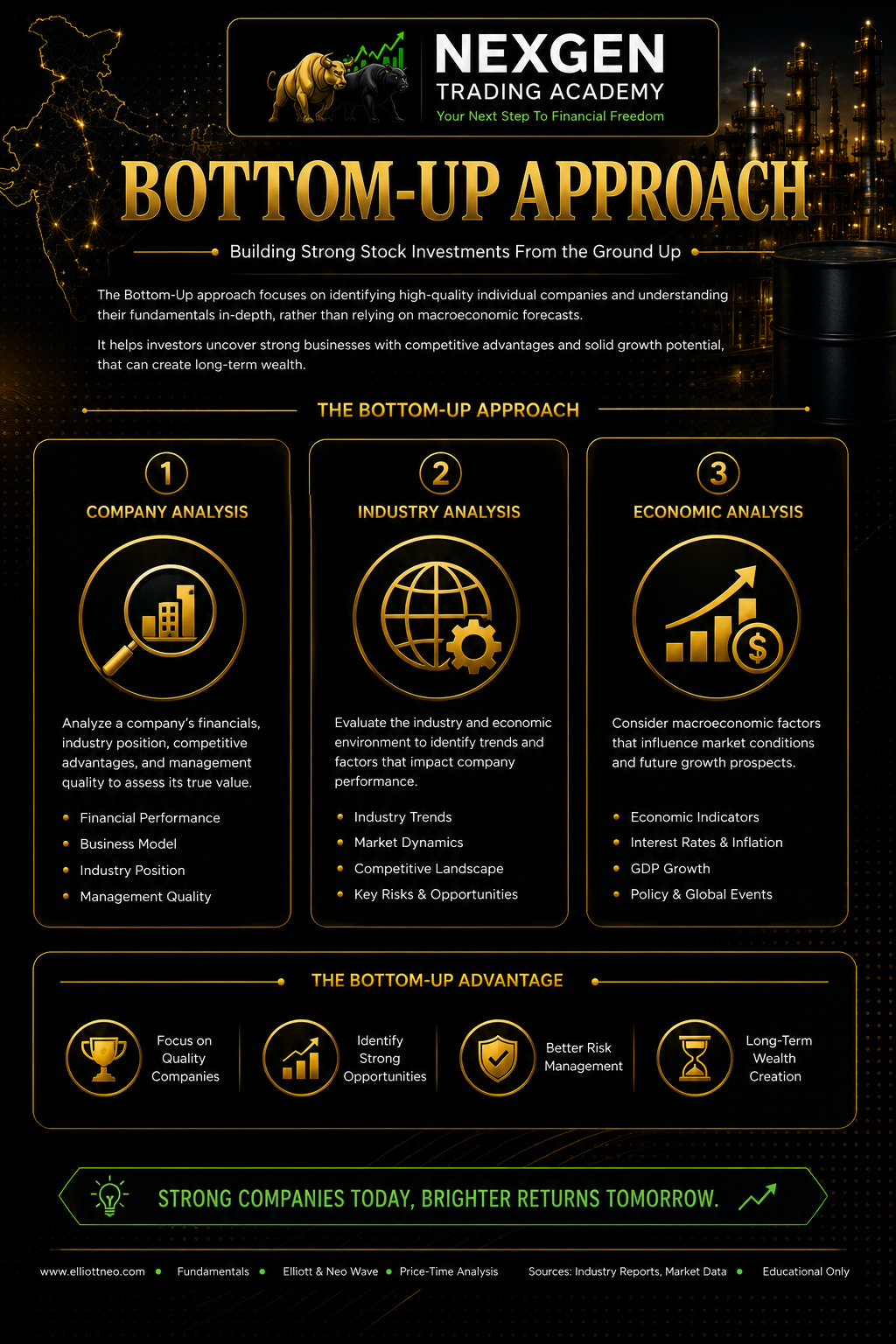
Core Principle: Bottom-Up Approach for Stock Investing
Core Concepts & Foundational Principles
Mastering bottom-up approach for stock investing builds lasting financial clarity, confidence, and disciplined execution.
Summary & Key Takeaways
Mastering bottom-up approach for stock investing is vital for developing sound financial and investment discipline..
Key Mechanics & Frameworks
Consistent long-term habits create significantly greater wealth than short-term speculative decisions..
Continuous study and structured application of Macro Factors in Stock Investing A Comprehensive Guide to Economic Analysis, Industry Evaluation, and Company Selection for Long-Term Investors empowers smart decision-making..
Summary & Key Takeaways
- Consistent long-term habits create significantly greater wealth than short-term speculative decisions.
- Mastering bottom-up approach for stock investing is vital for developing sound financial and investment discipline.
- Summary & Key Takeaways.