Top-Down Approach for Stock Investing
Successful investing is not limited to identifying companies with strong financial statements or well-known brands. Every business functions within an economic environment that constantly evolves due to changes in government policies, interest rates, inflation, technological developments, consumer behaviour, and global events. These macroeconomic forces influence industries differently and determine which sectors are likely to experience growth or decline during different phases of the economic cycle. Investors who understand these broader economic relationships are often able to identify favourable investment opportunities before they become widely recognized by the market. One of the most systematic methods of integrating macroeconomic analysis into stock selection is known as the Top-Down Approach for Stock Investing.The Top-Down Approach is an investment strategy that begins with analysing the overall economy before narrowing the focus to individual industries, sectors, and finally specific companies. Instead of starting with a company's financial statements, investors first evaluate macroeconomic conditions to determine which sectors are likely to benefit from the prevailing economic environment. After identifying attractive industries, they analyse companies operating within those sectors to select businesses with strong financial performance, competitive advantages, and long-term growth potential.The philosophy behind the Top-Down Approach is based on a simple but powerful principle: even excellent companies are influenced by the economic conditions in which they operate. During periods of economic expansion, many industries experience rising demand, improving profitability, and increasing investor confidence. Conversely, during economic slowdowns or recessions, even fundamentally strong businesses may face declining sales, lower earnings, and reduced valuations. Therefore, understanding the broader economy enables investors to identify industries that are most likely to benefit from current and future economic trends.The Top-Down Approach generally follows a logical sequence. Investors first study the overall economy, then identify industries expected to perform well under those conditions, and finally evaluate individual companies within those industries. Each stage of analysis builds upon the previous one, allowing investors to gradually narrow thousands of listed companies into a carefully selected group of high-quality investment opportunities.The first stage of the Top-Down Approach involves economic analysis. Investors begin by evaluating the health and direction of the overall economy. They examine important macroeconomic indicators such as Gross Domestic Product (GDP) growth, inflation, interest rates, employment levels, industrial production, consumer spending, government expenditure, taxation policies, fiscal deficits, exchange rates, and monetary policy. These indicators help investors determine whether the economy is expanding, slowing down, or entering a recession.Economic growth plays a particularly important role because it directly influences corporate profitability. During periods of strong economic expansion, consumers generally spend more, businesses increase production, employment rises, and companies invest in future growth. As a result, corporate revenues and profits often improve across many industries. In contrast, weaker economic growth typically reduces business investment, lowers consumer demand, and slows corporate earnings growth.Interest rates represent another critical economic variable within the Top-Down Approach. Central banks adjust interest rates to manage inflation and support economic stability. Lower interest rates reduce borrowing costs for businesses and consumers, encouraging investment, housing demand, automobile purchases, and infrastructure development. Industries such as banking, real estate, automobiles, construction, and capital goods often benefit significantly from lower interest rates. Conversely, rising interest rates increase financing costs, reduce borrowing, and may slow economic activity, affecting interest-sensitive industries more severely.Inflation is equally important because it influences production costs, consumer purchasing power, and corporate profitability. Moderate inflation often accompanies healthy economic growth, while persistently high inflation may increase operating expenses and reduce consumer demand. Investors using the Top-Down Approach evaluate which industries possess the ability to pass higher costs on to customers and which businesses may struggle to maintain profitability under inflationary conditions.Government policies also influence economic activity in significant ways. Fiscal policy, taxation, public infrastructure spending, subsidies, industrial incentives, environmental regulations, import duties, export policies, and labour laws all shape the business environment. Investors carefully monitor policy changes because government decisions often create opportunities for some industries while presenting challenges for others. Infrastructure spending, renewable energy initiatives, digital transformation programs, healthcare reforms, and manufacturing incentives frequently influence sector performance for many years.Once investors develop a comprehensive understanding of the overall economy, the second stage of the Top-Down Approach involves industry selection. Different industries respond differently to changing economic conditions. Identifying sectors expected to benefit from prevailing macroeconomic trends significantly improves the probability of selecting companies capable of delivering sustainable financial performance.For example, during periods of strong economic expansion, industries such as banking, construction, infrastructure, automobiles, capital goods, consumer discretionary products, and real estate often experience higher demand because businesses expand and consumers increase spending. Conversely, during economic uncertainty or recession, defensive sectors such as healthcare, pharmaceuticals, utilities, and consumer staples often demonstrate greater stability because demand for essential goods and services remains relatively consistent regardless of economic conditions.Investors must also recognise that industry performance depends not only on economic growth but also on structural changes within society. Technological innovation, demographic shifts, environmental sustainability, digital transformation, urbanization, and changing consumer preferences create long-term growth opportunities that may extend well beyond traditional economic cycles. Industries benefiting from these structural trends often attract considerable investor attention because they possess the potential for sustained expansion over many years.After identifying attractive industries, investors proceed to the third stage of the Top-Down Approach by conducting company analysis. At this stage, the objective is to identify businesses capable of outperforming their industry peers. Even within attractive industries, companies differ significantly in management quality, financial strength, operational efficiency, competitive advantages, innovation capability, and capital allocation. Investors therefore analyse business models, financial statements, profitability, debt levels, cash flow, corporate governance, valuation, and long-term growth prospects before selecting specific companies for investment.Fundamental analysis plays an essential role during this stage. Investors evaluate revenue growth, earnings consistency, Return on Equity, Return on Capital Employed, operating margins, debt-to-equity ratio, cash generation, and valuation metrics to determine whether the company represents an attractive long-term investment. Qualitative factors such as management quality, competitive positioning, brand reputation, customer loyalty, and innovation capability also receive careful consideration.One of the greatest strengths of the Top-Down Approach is that it aligns investment decisions with prevailing economic conditions. Rather than selecting companies randomly, investors focus their attention on industries expected to benefit from current macroeconomic trends. This structured approach increases the likelihood that favourable economic conditions will support corporate earnings growth and investor confidence simultaneously.The Top-Down Approach also encourages investors to develop a broader understanding of financial markets. Instead of analysing companies in isolation, investors appreciate the relationships between economic growth, government policy, industry performance, and corporate profitability. This broader perspective often improves portfolio diversification because investments are distributed across industries expected to perform well under different economic conditions.Another important advantage is improved risk management. By understanding macroeconomic conditions before selecting companies, investors may avoid industries facing structural challenges or unfavourable policy environments. For example, if rising interest rates are expected to reduce housing demand, investors may choose to limit exposure to highly leveraged real estate companies while increasing investments in sectors less sensitive to borrowing costs.The Top-Down Approach is particularly useful for sector rotation strategies, where investors shift capital between industries according to changing economic conditions. As economies move through different phases of the business cycle, certain sectors naturally outperform others. Investors who recognise these transitions may position their portfolios to benefit from evolving economic trends rather than maintaining identical sector allocations regardless of changing circumstances.Despite its advantages, the Top-Down Approach also has certain limitations. Macroeconomic forecasting is inherently uncertain because economies are influenced by numerous variables that cannot always be predicted accurately. Unexpected political developments, natural disasters, global conflicts, technological disruptions, financial crises, or pandemics may significantly alter economic conditions within short periods. Investors should therefore avoid excessive reliance on economic forecasts alone.Another limitation is that exceptional companies occasionally outperform despite unfavourable macroeconomic conditions. Businesses possessing durable competitive advantages, strong brands, innovative products, or outstanding management may continue generating attractive returns even during economic slowdowns. Investors relying exclusively on macroeconomic analysis may overlook such opportunities if they dismiss entire industries based solely on economic expectations.For this reason, successful investors often combine the Top-Down Approach with detailed company-level analysis. Economic conditions provide valuable context, but long-term investment success ultimately depends on owning businesses capable of generating sustainable earnings, maintaining competitive advantages, and adapting to changing market conditions. Macroeconomic analysis should therefore complement rather than replace comprehensive fundamental analysis.The Top-Down Approach also requires continuous monitoring because economic conditions evolve over time. Interest rates, inflation, government policies, global trade relationships, commodity prices, and consumer behaviour change continuously, influencing industry prospects and corporate performance. Investors following this approach regularly review macroeconomic developments to ensure that their investment assumptions remain valid.Ultimately, the Top-Down Approach provides a logical framework for integrating macroeconomic understanding with stock selection. It encourages investors to think systematically by beginning with the broader economy, identifying favourable industries, and selecting fundamentally strong companies capable of benefiting from those conditions. This structured process reduces random stock selection while improving the quality of long-term investment decisions.In conclusion, the Top-Down Approach for Stock Investing is a disciplined investment methodology that begins with analysing the overall economy before evaluating industries and individual companies. By studying macroeconomic indicators, government policies, industry trends, and business fundamentals, investors gain a comprehensive understanding of the environment in which companies operate. This approach enables investors to identify sectors with favourable growth prospects and select businesses capable of creating sustainable shareholder value. When combined with careful fundamental analysis and long-term discipline, the Top-Down Approach serves as a powerful framework for making informed investment decisions based on both economic conditions and business quality.
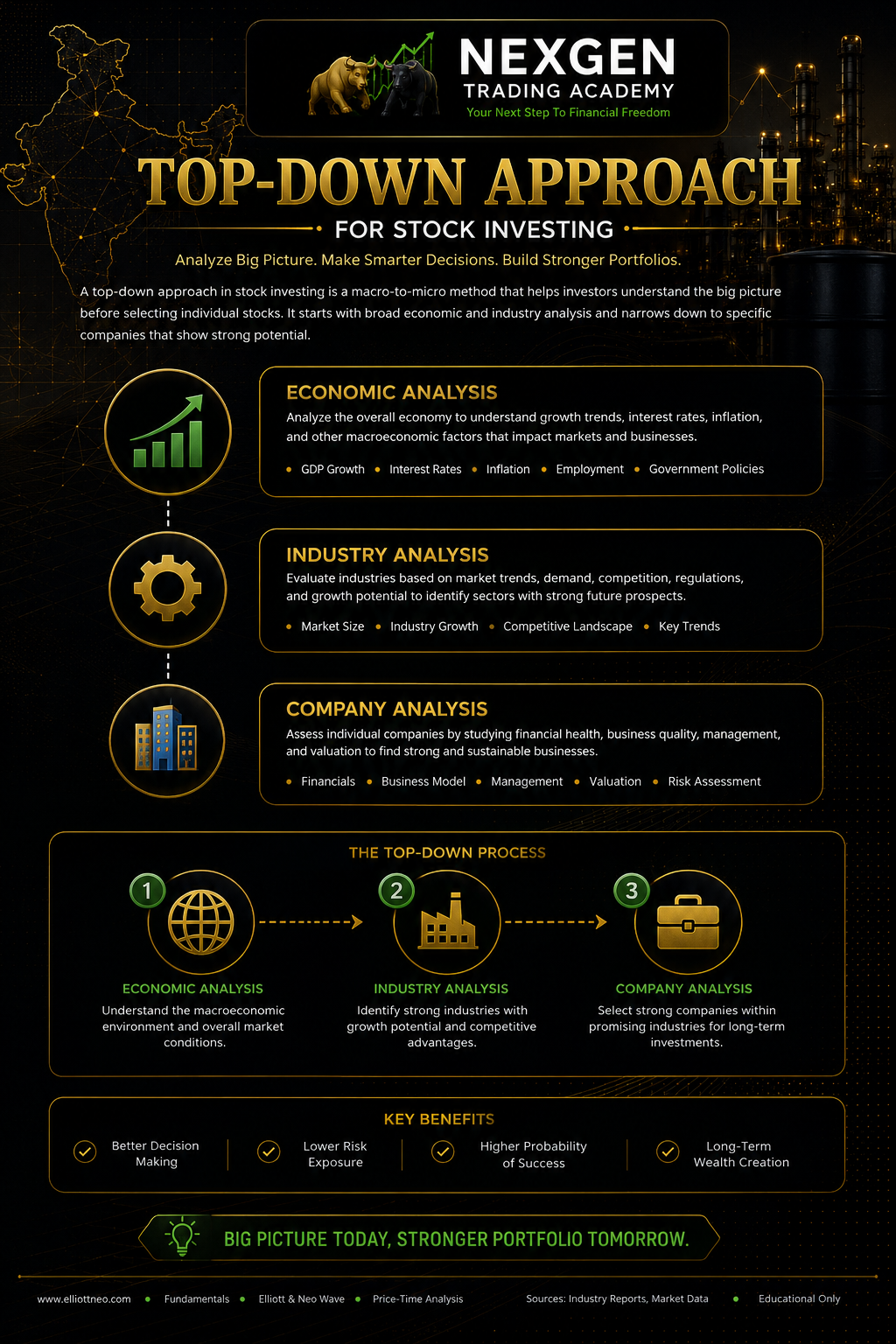
Core Principle: Top-Down Approach for Stock Investing
Core Concepts & Foundational Principles
Mastering top-down approach for stock investing builds lasting financial clarity, confidence, and disciplined execution.
Summary & Key Takeaways
Mastering top-down approach for stock investing is vital for developing sound financial and investment discipline..
Key Mechanics & Frameworks
Consistent long-term habits create significantly greater wealth than short-term speculative decisions..
Continuous study and structured application of Macro Factors in Stock Investing A Comprehensive Guide to Economic Analysis, Industry Evaluation, and Company Selection for Long-Term Investors empowers smart decision-making..
Summary & Key Takeaways
- Consistent long-term habits create significantly greater wealth than short-term speculative decisions.
- Mastering top-down approach for stock investing is vital for developing sound financial and investment discipline.
- Summary & Key Takeaways.