PESTEL Analysis
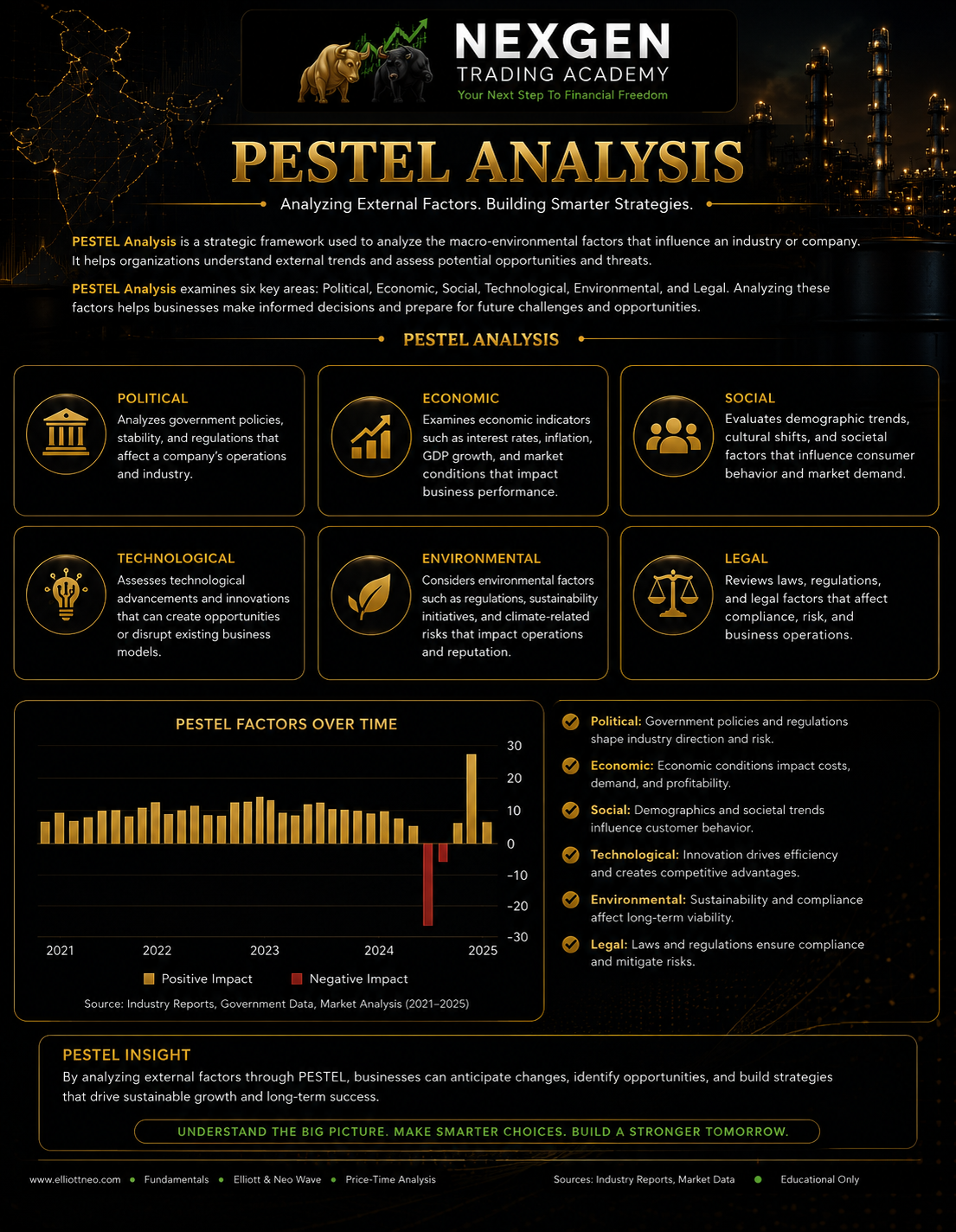
Every business operates within an environment that extends far beyond its products, customers, and competitors. While internal factors such as management quality, financial performance, operational efficiency, and competitive advantages significantly influence a company's success, external forces often shape the opportunities and challenges that businesses face throughout their lifecycle. Governments introduce new policies, economies expand and contract, societies adopt new lifestyles, technologies evolve rapidly, environmental concerns become increasingly important, and legal frameworks continue to change. These external developments affect every industry to varying degrees and influence the long-term growth prospects of companies. Investors who understand these broader influences are better equipped to evaluate business risks and identify sustainable investment opportunities. One of the most widely accepted frameworks for analysing these external influences is known as PESTEL Analysis.PESTEL Analysis is a strategic framework used to examine the external macro-environmental factors that influence businesses and industries. The acronym PESTEL represents Political, Economic, Social, Technological, Environmental, and Legal factors. Each of these elements shapes the environment in which businesses operate and affects their ability to generate sustainable profits over the long term. Unlike financial statement analysis, which focuses on the internal performance of a company, PESTEL Analysis evaluates external conditions that remain largely outside the direct control of management but significantly influence business performance.For investors, PESTEL Analysis serves as an important complement to fundamental analysis. Financial statements reveal how a company has performed in the past, whereas PESTEL Analysis helps investors understand the external conditions that may influence future growth. Businesses that successfully adapt to changing political, economic, social, technological, environmental, and legal conditions often maintain stronger competitive positions than those that fail to respond effectively to external changes.The first component of PESTEL Analysis is the Political Factor. Political conditions influence business operations through government policies, political stability, taxation, public expenditure, trade agreements, industrial incentives, subsidies, foreign investment regulations, labour policies, and administrative decisions. Governments play an important role in shaping the business environment because they establish the regulatory framework within which companies operate.Political stability generally encourages investment by creating confidence among businesses and investors. Stable governments often implement consistent economic policies that support long-term planning, infrastructure development, industrial expansion, and capital investment. Conversely, political uncertainty may delay investment decisions because businesses become cautious when future policies remain unclear. Investors therefore monitor political developments carefully to assess how government decisions may influence different industries.Taxation policies also have a significant impact on corporate profitability. Lower corporate tax rates generally improve earnings by allowing companies to retain a greater proportion of their profits. Conversely, higher taxation may reduce profitability and influence future investment decisions. Government incentives for sectors such as renewable energy, manufacturing, infrastructure, healthcare, and technology frequently create attractive long-term opportunities for businesses operating within these industries.Trade policies represent another important political consideration. Import duties, export incentives, free trade agreements, and international relations influence industries engaged in global commerce. Export-oriented businesses often benefit from supportive trade policies, while industries dependent on imported raw materials may experience higher production costs when tariffs increase. Investors should therefore evaluate how political decisions influence supply chains, production costs, and international competitiveness.The second component of PESTEL Analysis is the Economic Factor. Economic conditions influence consumer purchasing power, business investment, employment, inflation, interest rates, exchange rates, and overall market demand. Since businesses operate within the broader economy, changes in macroeconomic conditions significantly affect corporate earnings and investment opportunities.One of the most important economic indicators is Gross Domestic Product (GDP) growth. Rising GDP generally reflects increasing production, expanding business activity, higher employment, and stronger consumer spending. Businesses operating during periods of sustained economic expansion often experience favourable conditions for increasing revenue and profitability. Slowing economic growth, however, may reduce demand, delay investment, and weaken corporate earnings across multiple industries.Interest rates also play a central role in economic analysis. Lower interest rates reduce borrowing costs for businesses and consumers, encouraging investment, housing demand, automobile purchases, and industrial expansion. Higher interest rates increase financing costs, reducing borrowing and slowing economic activity. Different industries respond differently to changes in interest rates, making economic analysis essential for investors evaluating sector performance.Inflation represents another important economic factor. Moderate inflation often accompanies healthy economic growth, while persistently high inflation increases production costs and reduces consumer purchasing power. Companies possessing strong pricing power may successfully transfer higher costs to customers, whereas businesses operating in highly competitive markets may experience declining profit margins. Investors therefore analyse inflation to understand its potential impact on different industries and companies.Currency movements also influence business performance, particularly for companies involved in international trade. A weaker domestic currency often benefits exporters because foreign earnings translate into higher local currency revenue. Conversely, businesses dependent on imported raw materials may face rising costs when the domestic currency depreciates. Understanding these relationships enables investors to evaluate how economic conditions affect company profitability.The third component is the Social Factor. Social factors represent changes in demographics, consumer behaviour, education, income distribution, cultural values, lifestyle preferences, population growth, urbanization, and public attitudes. These developments influence demand for products and services while creating new business opportunities across different industries.Population growth, for example, increases demand for housing, education, healthcare, transportation, consumer goods, and financial services. Urbanization creates opportunities for infrastructure development, real estate, retail businesses, and public transportation. Rising income levels often increase spending on discretionary products such as automobiles, travel, entertainment, premium consumer goods, and technology products.Consumer preferences continuously evolve because of changing lifestyles and technological adoption. Businesses capable of identifying and responding to these changes often maintain stronger competitive positions. The increasing emphasis on health and wellness has supported growth in healthcare, fitness, organic food, and pharmaceutical industries. Similarly, growing environmental awareness has increased demand for electric vehicles, renewable energy, and sustainable consumer products.Education levels and workforce skills also influence economic development. Better education often supports technological innovation, entrepreneurship, and productivity improvements, benefiting industries dependent on skilled professionals. Investors should therefore consider long-term demographic and social trends when evaluating future business opportunities.The fourth component of PESTEL Analysis is the Technological Factor. Technological advancement has become one of the most influential drivers of business transformation in the modern economy. Innovation affects production methods, customer experience, communication, logistics, marketing, financial services, healthcare, education, manufacturing, and virtually every aspect of business operations.Companies investing consistently in research and development often strengthen their competitive advantages by introducing innovative products, improving operational efficiency, and reducing production costs. Technological innovation also enables businesses to automate processes, improve supply chain management, analyse customer data, and deliver superior services through digital platforms.At the same time, technological disruption may threaten businesses that fail to adapt. Companies relying on outdated technologies or traditional business models may gradually lose market share to more innovative competitors. Investors therefore evaluate whether businesses possess the capability to embrace technological change rather than resist it.Digital transformation has accelerated significantly in recent years. Cloud computing, artificial intelligence, machine learning, automation, blockchain technology, data analytics, cybersecurity, and digital payments have reshaped numerous industries. Investors should assess whether companies actively invest in technology that strengthens long-term competitiveness rather than merely responding to immediate market pressures.The fifth component is the Environmental Factor. Environmental considerations have become increasingly important as governments, businesses, and consumers focus greater attention on sustainability, climate change, resource conservation, pollution control, and responsible corporate behaviour.Businesses now face growing expectations regarding environmental responsibility. Companies are increasingly expected to reduce carbon emissions, improve energy efficiency, minimize waste generation, conserve natural resources, and adopt sustainable production practices. Environmental regulations continue to evolve globally, influencing industries such as energy, manufacturing, mining, transportation, agriculture, and construction.At the same time, environmental awareness creates significant business opportunities. Renewable energy, electric vehicles, recycling technologies, water management, sustainable packaging, green buildings, and environmentally friendly consumer products represent rapidly expanding industries supported by changing consumer preferences and government initiatives. Investors who recognise these long-term trends may identify businesses positioned to benefit from the global transition toward sustainability.Natural disasters and climate-related risks also influence business operations. Floods, droughts, extreme weather events, and resource shortages may disrupt supply chains, increase production costs, or affect agricultural output. Companies demonstrating effective environmental risk management often possess greater operational resilience than businesses unprepared for such challenges.The final component of PESTEL Analysis is the Legal Factor. Every business operates within a legal framework established by governments and regulatory authorities. Laws governing corporate governance, labour relations, taxation, consumer protection, competition, environmental compliance, intellectual property, financial reporting, and product safety all influence business operations.Regulatory compliance has become increasingly important because failure to comply with legal requirements may result in financial penalties, operational restrictions, reputational damage, or legal disputes. Investors therefore examine whether companies maintain strong governance practices, transparent reporting, ethical conduct, and effective compliance systems.Intellectual property laws also play a significant role in many industries. Patents, trademarks, copyrights, and proprietary technologies provide legal protection that enables businesses to maintain competitive advantages. Pharmaceutical, technology, software, and consumer goods companies often derive substantial value from intellectual property rights, making legal protection an important consideration for investors.Labour laws influence employment practices, wages, working conditions, employee benefits, and industrial relations. Changes in labour regulations may affect production costs and operational flexibility, particularly for labour-intensive industries. Consumer protection laws similarly influence product quality standards, marketing practices, warranties, and customer rights.One of the greatest strengths of PESTEL Analysis is its ability to encourage long-term thinking. Rather than concentrating solely on current financial performance, investors evaluate how external developments may influence future business prospects. Companies that anticipate changes in political policies, economic conditions, consumer behaviour, technology, environmental expectations, and legal requirements are generally better positioned to maintain sustainable growth than businesses reacting only after changes occur.However, investors should also recognize that PESTEL Analysis does not produce definitive investment decisions by itself. External conditions affect industries differently, and businesses vary considerably in their ability to respond to changing environments. Strong management, sound financial performance, innovation, and competitive advantages often enable companies to perform well even under challenging external conditions. PESTEL Analysis should therefore complement rather than replace company-specific fundamental analysis.Ultimately, PESTEL Analysis provides investors with a structured framework for understanding the broader environment influencing business success. By systematically evaluating political, economic, social, technological, environmental, and legal factors, investors develop a more comprehensive understanding of both opportunities and risks affecting long-term corporate performance.In conclusion, PESTEL Analysis is an essential strategic framework that enables investors to evaluate the external macro-environment surrounding businesses and industries. By analysing Political, Economic, Social, Technological, Environmental, and Legal factors, investors gain valuable insight into the broader forces influencing corporate profitability, competitive positioning, and long-term sustainability. When integrated with economic analysis, industry evaluation, and company-specific research, PESTEL Analysis strengthens investment decision-making by providing a comprehensive understanding of the dynamic environment in which businesses operate and compete.
Mastering pestel analysis builds lasting financial clarity, confidence, and disciplined execution.
Core Concepts & Foundational Principles
Summary & Key Takeaways
Mastering pestel analysis is vital for developing sound financial and investment discipline..
Core Principle: PESTEL Analysis
Key Mechanics & Frameworks
Consistent long-term habits create significantly greater wealth than short-term speculative decisions..
Continuous study and structured application of Macro Factors in Stock Investing A Comprehensive Guide to Economic Analysis, Industry Evaluation, and Company Selection for Long-Term Investors empowers smart decision-making..
Summary & Key Takeaways
- Consistent long-term habits create significantly greater wealth than short-term speculative decisions.
- Mastering pestel analysis is vital for developing sound financial and investment discipline.
- Summary & Key Takeaways.