Company Analysis
After understanding the economy, evaluating industries, and studying the external factors that influence businesses, the final and most important step in the investment process is analysing the company itself. While favourable economic conditions and growing industries create opportunities, they do not guarantee that every company operating within those sectors will succeed. Businesses differ significantly in their management quality, financial strength, operational efficiency, competitive advantages, innovation capability, and ability to generate long-term shareholder value. Therefore, investors must conduct a detailed assessment of individual companies before making any investment decision. This systematic evaluation is known as Company Analysis, and it forms the foundation of successful fundamental investing.Company Analysis is the process of evaluating every important aspect of a business to determine its financial health, competitive position, operational efficiency, growth potential, and overall investment attractiveness. It involves examining both qualitative and quantitative factors, including the company's business model, products and services, management quality, financial statements, competitive advantages, industry position, valuation, risks, and long-term sustainability. The primary objective of company analysis is to determine whether a business is capable of creating consistent value for its shareholders over an extended period.Successful investors recognize that purchasing a share means purchasing a partial ownership interest in a real business. Consequently, investment decisions should never be based solely on stock price movements or short-term market sentiment. Instead, investors should seek to understand how the business operates, how it generates revenue, whether its earnings are sustainable, and whether it possesses the characteristics necessary to remain successful in the future.The first step in company analysis is understanding the business model. Every company follows a particular method of creating value by producing goods or delivering services to customers. Investors should clearly understand what products or services the company offers, who its customers are, how it earns revenue, and what factors drive its profitability. Businesses with simple, transparent, and understandable business models are generally easier to evaluate than companies operating in highly complex or rapidly changing industries.Understanding the business model also helps investors assess whether the company's growth is sustainable. Businesses providing essential products or services that remain relevant over long periods often possess more predictable earnings than companies dependent upon temporary consumer trends or speculative demand. Investors should therefore determine whether the company's business model addresses genuine long-term customer needs and whether future demand is likely to remain stable.The next important aspect of company analysis is evaluating the company's products and services. Investors should examine whether the company's offerings solve meaningful customer problems, possess strong market demand, and maintain competitive differentiation. Businesses offering high-quality products supported by customer loyalty often enjoy stronger pricing power and greater resilience during periods of economic uncertainty.Product diversification also contributes to business stability. Companies generating revenue from multiple products, services, or customer segments generally face lower business risk than businesses dependent upon a single product line. Diversification reduces the impact of changing customer preferences or declining demand within any one category, improving long-term financial stability.Management quality is one of the most significant qualitative factors influencing business success. Even companies operating within attractive industries may underperform if management lacks strategic vision, financial discipline, or operational competence. Investors therefore devote considerable attention to evaluating the leadership responsible for guiding the company's future.Effective management demonstrates integrity, transparency, long-term thinking, and responsible capital allocation. Investors often assess management quality by studying annual reports, shareholder communications, corporate governance practices, strategic decisions, and the company's historical financial performance. Management teams that consistently communicate honestly with shareholders and deliver sustainable financial results generally inspire greater investor confidence than those making unrealistic promises or pursuing short-term market popularity.Corporate governance also plays an important role in company analysis. Strong governance practices ensure that management acts in the best interests of shareholders while maintaining ethical standards, regulatory compliance, and financial transparency. Independent boards of directors, effective internal controls, transparent financial reporting, and responsible executive compensation policies contribute to stronger governance and reduced operational risk.Financial analysis represents another essential component of company evaluation. Investors carefully examine the company's financial statements to determine profitability, liquidity, operational efficiency, financial stability, and cash generation. Revenue growth, operating profit, net profit, earnings per share, return on equity, return on capital employed, debt-to-equity ratio, operating cash flow, and free cash flow all provide valuable insight into the company's financial performance.Rather than relying on a single year's financial results, experienced investors compare financial statements across multiple years to identify long-term trends. Consistent revenue growth, improving profit margins, stable debt levels, increasing cash flow, and strengthening shareholder equity often indicate a financially healthy business capable of sustaining future growth. Temporary fluctuations may occur in every business, but long-term consistency generally reflects effective management and sound operational execution.Cash flow deserves particular attention because it demonstrates the company's ability to generate actual cash from its operations. While accounting profits may include non-cash adjustments or temporary accounting estimates, operating cash flow reflects the company's ability to finance daily operations, repay debt, invest in expansion, and distribute dividends without excessive dependence on external financing. Businesses consistently generating positive operating and free cash flow generally possess greater financial flexibility than companies struggling to convert accounting profits into cash.Another important aspect of company analysis is identifying the company's competitive advantage. Successful businesses rarely achieve long-term profitability without possessing characteristics that distinguish them from competitors. These advantages, often referred to as economic moats, protect the company from competitive pressures while supporting sustainable earnings growth.Competitive advantages may arise from strong brands, proprietary technology, patents, efficient manufacturing processes, superior customer service, extensive distribution networks, cost leadership, intellectual property, or network effects. Companies possessing durable competitive advantages generally maintain stronger profitability because competitors find it difficult to replicate their strengths. Investors should determine whether these advantages are sustainable or whether competitors can easily erode the company's market position.Market position also influences long-term business success. Industry-leading companies often benefit from economies of scale, stronger customer recognition, wider distribution capabilities, and greater bargaining power than smaller competitors. Investors should compare the company's performance with its industry peers to evaluate whether it maintains a leadership position or faces significant competitive disadvantages.Innovation represents another important factor within company analysis. Industries continuously evolve because of technological advancement, changing consumer preferences, and competitive developments. Companies investing consistently in research and development often strengthen their long-term competitiveness by introducing new products, improving production efficiency, and responding effectively to changing market conditions. Investors should evaluate whether the company demonstrates a culture of innovation or relies excessively on past successes without adapting to future challenges.No company analysis is complete without evaluating risk. Every business faces uncertainties arising from economic conditions, industry competition, technological disruption, regulatory changes, supply chain challenges, currency fluctuations, environmental issues, and operational risks. Investors should identify the principal risks affecting the company and assess whether management possesses effective strategies for managing those challenges.Customer concentration also deserves careful consideration. Companies generating a large proportion of revenue from a limited number of customers face greater business risk because the loss of a major customer may significantly affect financial performance. Similarly, dependence upon a small number of suppliers may expose businesses to supply chain disruptions or increased input costs. Diversified customer and supplier relationships generally contribute to greater operational stability.Valuation is another critical stage of company analysis. Even an outstanding business may not represent an attractive investment if its shares are trading at an excessively high price. Investors therefore compare the company's intrinsic value with its current market valuation before making investment decisions. Financial ratios such as the Price-to-Earnings Ratio, Price-to-Book Ratio, Enterprise Value multiples, and discounted cash flow estimates assist investors in determining whether the stock is reasonably valued relative to its long-term earning potential.However, valuation should never be viewed independently of business quality. A low valuation does not automatically indicate a good investment because companies experiencing declining profitability or structural challenges may appear inexpensive for valid reasons. Likewise, exceptional businesses sometimes trade at higher valuations because investors recognize their superior long-term growth potential. Successful investors seek an appropriate balance between business quality and reasonable valuation.Dividend policy also provides useful information regarding capital allocation. Some companies distribute a portion of their profits to shareholders through regular dividends, while others retain earnings to finance future expansion. Neither approach is inherently superior. Investors should evaluate whether the company's capital allocation decisions support long-term shareholder value rather than focusing solely on dividend yield.Investors should also examine the company's future growth opportunities. Expansion into new markets, product innovation, technological advancement, capacity expansion, strategic acquisitions, operational efficiency improvements, and favourable industry trends may all contribute to long-term earnings growth. Businesses capable of reinvesting profits at attractive rates of return often create greater shareholder value than companies with limited growth prospects.Another valuable technique in company analysis is peer comparison. Comparing financial performance, profitability, margins, debt levels, cash flow, market share, and valuation with similar companies operating within the same industry provides greater context for evaluating business quality. Industry comparisons help investors distinguish genuinely superior businesses from companies merely benefiting from favourable sector conditions.Company analysis should always remain dynamic rather than static. Businesses continuously evolve as management introduces new strategies, competitors respond, technologies advance, and economic conditions change. Investors should therefore review company performance regularly through quarterly results, annual reports, management discussions, investor presentations, and regulatory filings to ensure that the original investment thesis remains valid.Ultimately, company analysis represents the final stage in integrating macroeconomic understanding, industry evaluation, and business-specific research. Economic conditions determine the overall investment environment, industry analysis identifies attractive sectors, and company analysis enables investors to select businesses capable of delivering sustainable long-term returns. This comprehensive approach significantly improves investment quality by ensuring that every investment decision is supported by systematic research rather than speculation or market sentiment.In conclusion, Company Analysis is the cornerstone of fundamental investing because it enables investors to evaluate the financial strength, competitive position, management quality, operational efficiency, valuation, and long-term growth potential of individual businesses. By understanding business models, analysing financial statements, assessing competitive advantages, identifying risks, comparing industry peers, and evaluating future opportunities, investors develop a comprehensive understanding of whether a company is capable of creating sustainable shareholder value. When combined with economic analysis, industry evaluation, and disciplined investment principles, company analysis provides a complete framework for making informed long-term investment decisions based on business fundamentals rather than short-term market fluctuations.
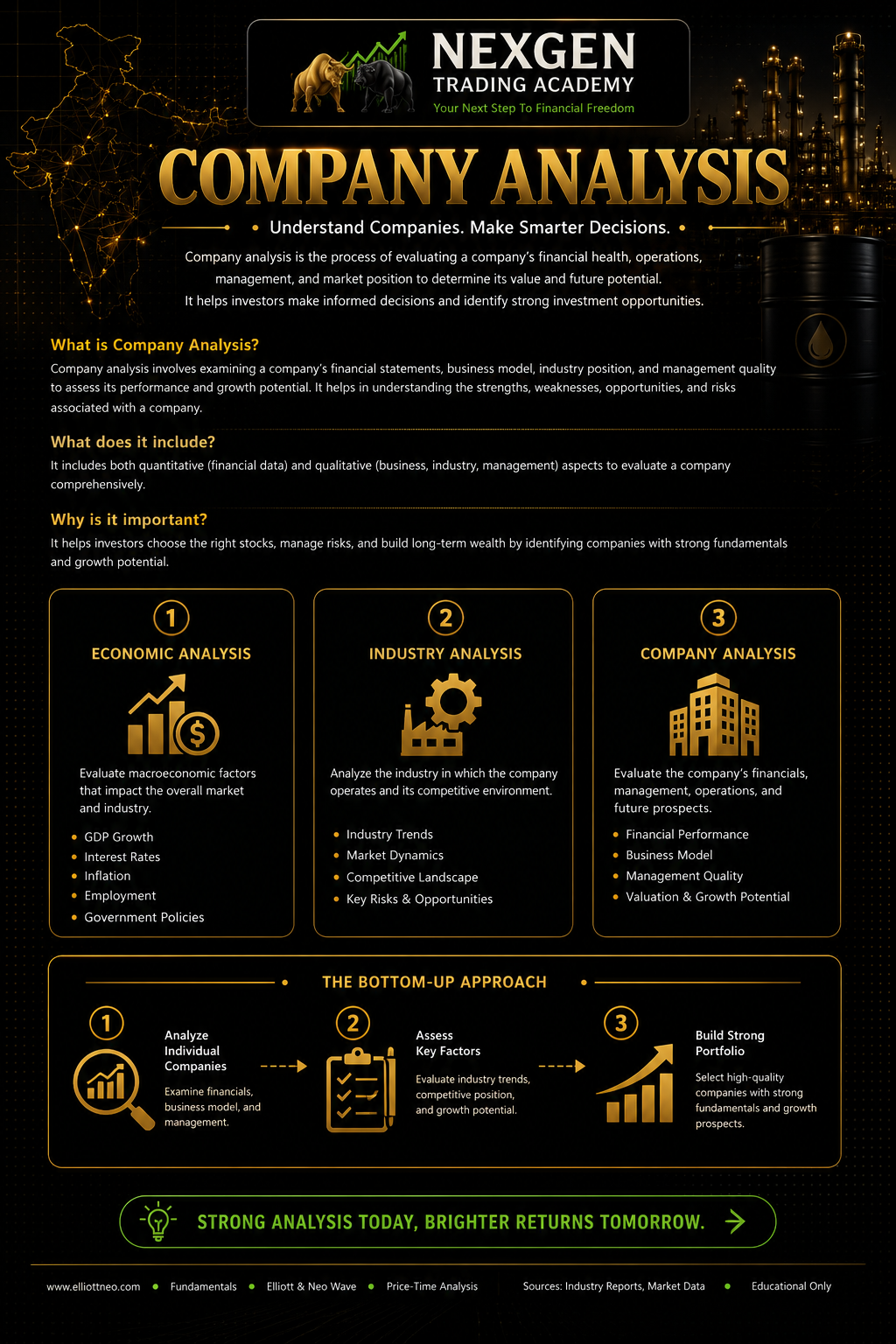
Mastering company analysis builds lasting financial clarity, confidence, and disciplined execution.
Core Concepts & Foundational Principles
Summary & Key Takeaways
Mastering company analysis is vital for developing sound financial and investment discipline..
Core Principle: Company Analysis
Key Mechanics & Frameworks
Consistent long-term habits create significantly greater wealth than short-term speculative decisions..
Continuous study and structured application of Macro Factors in Stock Investing A Comprehensive Guide to Economic Analysis, Industry Evaluation, and Company Selection for Long-Term Investors empowers smart decision-making..
Summary & Key Takeaways
- Consistent long-term habits create significantly greater wealth than short-term speculative decisions.
- Mastering company analysis is vital for developing sound financial and investment discipline.
- Summary & Key Takeaways.